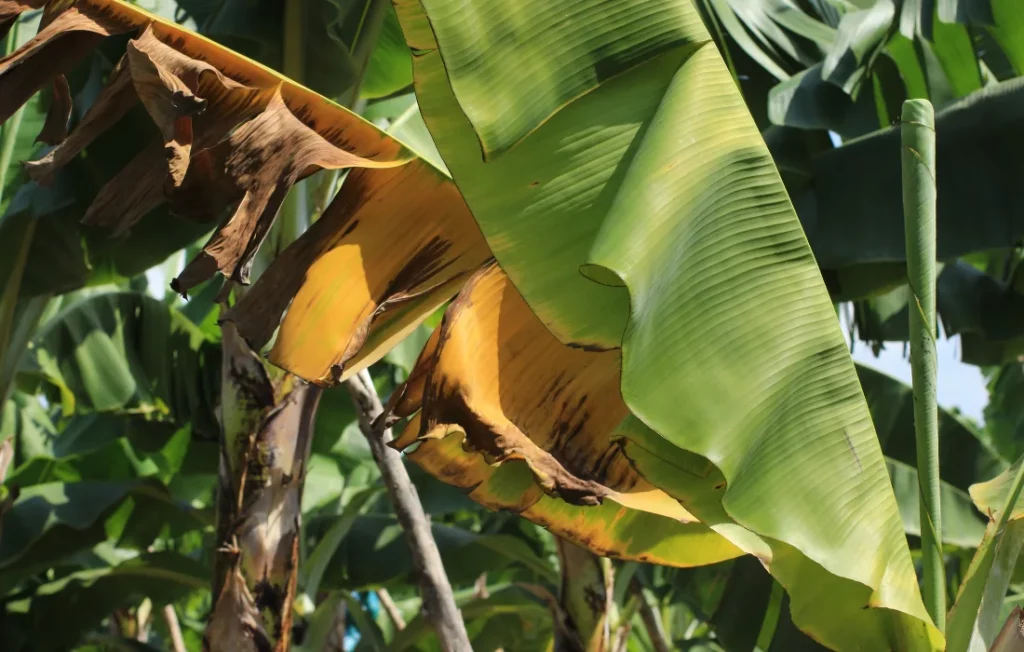
Fusarium wilt of bananas is one of the most destructive soilborne diseases in banana plantations. Caused by a microscopic fungus capable of surviving for many years in the soil, it disrupts the flow of water and nutrients, eventually leading to the complete death of the banana plant. For both growers and technicians, this disease presents a significant agronomic challenge: it necessitates a rethinking of soil management, the selection of planting material, and long-term cultivation practices.
What is banana fusarium wilt?
Banana fusarium wilt , also known as Panama disease , is a soilborne fungal disease that exclusively affects banana plants. It is caused by Fusarium oxysporum f. sp. cubense , a soil fungus belonging to the class Ascomycetes , the order Hypocreales , and the family Nectriaceae .
The most concerning form of the disease today is Fusarium wilt Tropical Race 4 of bananas (FOC TR4) . This race is distinguished by its ability to infect the Cavendish variety , a cornerstone of global banana production, which until now had been spared from historical forms of the disease. Fusarium wilt acts deep within the plant, affecting the root and vascular systems, which explains its slow, insidious, and often irreversible nature.
There are several races of Fusarium oxysporum f. sp. cubense :
- FOC TR1 : initially detected in Panama, responsible for the major epidemics of the early 20th century, having almost wiped out the “Gros Michel” variety, while the Cavendish remains tolerant there.
- FOC TR2 : mainly affects Bluggoe (ABB) type bananas and certain plantain varieties, with limited spread
- FOC TR3 : rarely associated with bananas, more often linked to other species in the Musaceae family
- FOC TR4 : the most aggressive strain known to date, infecting Cavendish, with very high persistence and invasive potential
History and geographical distribution
Fusarium wilt TR4 was first identified in 1960 in Taiwan . For several decades, it remained confined to certain areas of Asia, before experiencing a marked expansion from the 1990s onwards. This phase of rapid spread profoundly changed the perception of the health risk on an international scale.
Today, Fusarium wilt TR4 is present on three continents and has been officially detected in 21 countries . Its recent arrival in Venezuela between 2022 and 2023 has attracted particular attention due to its geographical proximity to the Caribbean. This situation reinforces vigilance in areas that are still unaffected.
In the French West Indies , no official detections have been reported. Faced with the threat, a reinforced health surveillance system is in place, aimed at anticipating any accidental introduction of the pathogen.
Do you need a natural solution for Panama disease?
Fusarium wilt development cycle
The fungus responsible for Fusarium wilt is naturally present in the soil. Infection begins in the roots , usually through small wounds or areas of active growth. Once established, the pathogen progresses to the bulb , then the pseudostem , gradually colonizing the vascular tissues.
Inside the plant, the fungus multiplies in the vascular system. In response, the banana plant produces a gelatinous substance intended to limit the invasion. Paradoxically, this response contributes to the obstruction of the vessels , blocking the flow of both raw and elaborated sap. The plant is then deprived of water and nutrients, which explains the widespread wilting observed.
The strength of Fusarium wilt also lies in its exceptional survival capacity . The fungus produces overwintering forms capable of remaining viable in the soil for more than ten years , sometimes several decades, even in the complete absence of a host plant. This persistence makes disease management particularly complex at the scale of a plot or a production basin.
Modes and factors of propagation
Fusarium wilt is not spread by air. Its spread relies primarily on the movement of soil, plant material or water, often linked to human activities and agricultural practices.
Main routes of dissemination
- Planting of suckers or seedlings from already infected banana trees
- Cultural work carried out without disinfection of equipment (leaf removal, bud removal)
- Transport of soil particles between plots
- Soil carried by shoes, clothing, tools or agricultural machinery
- Contaminated irrigation or runoff water
- Pathogen spread via canals and waterways
What are the symptoms of Fusarium wilt of banana trees?
Fusarium wilt affects several parts of the banana plant . The roots, bulb, pseudostem, and leaves are progressively affected as the fungus colonizes the vascular system. The damage caused by the disease, particularly the TR4 race, lies in its vascular and irreversible nature , leading to the decline and eventual death of the plant.
What we observe:
- Initial damage to the roots and bulb
- Generalized vascular withering
- Yellowing of the leaves, starting on the oldest ones
- Progression of symptoms from the bottom to the top of the banana tree
- Gradual drying of the leaves
- Leaves folding along the pseudostem
- Internal browning of leaf sheaths
- Visible dark red to brown coloration
- Possible bursting of the base of the pseudostem
The evolution of symptoms should always be analyzed with caution. Nutritional deficiencies such as potassium or magnesium deficiency, dehydration , or certain diseases such as Moko’s disease can cause partially similar signs. The timing of onset and, above all, the presence of internal vascular browning remain key elements in guiding the diagnosis.
What preventive measures should be taken?
Managing the disease relies primarily on upstream prevention:
- Exclusive use of healthy plants
- Plants are produced exclusively in approved nurseries.
- Prohibition or strict limitation of transfers of soil and plant material between plots
- Use of equipment, tools, clothing and footwear specifically designed for use in contaminated areas
- Disinfection of cutting and soil-working tools, boots and shoes
In the event of a confirmed infection, it is recommended to:
- Complete removal of infected clumps
- Total destruction of contaminated plants
- Intervention extended to neighboring plants
- Defining a safety radius adapted to the identified species of fungus
- Taking into account the particularly invasive nature of TR4 , requiring swift and widespread action.
Agrobiotop solutions for controlling banana fusarium wilt
Soil management: Aeration, oxygenation and decompaction of soils
Disease management
- CHITOPROTECT
- YAKADOP (Physical barrier against pests)
Do not hesitate to contact us for more information on the protocol to apply against this pest..
Photo : Shutterstock
Other Banana diseases