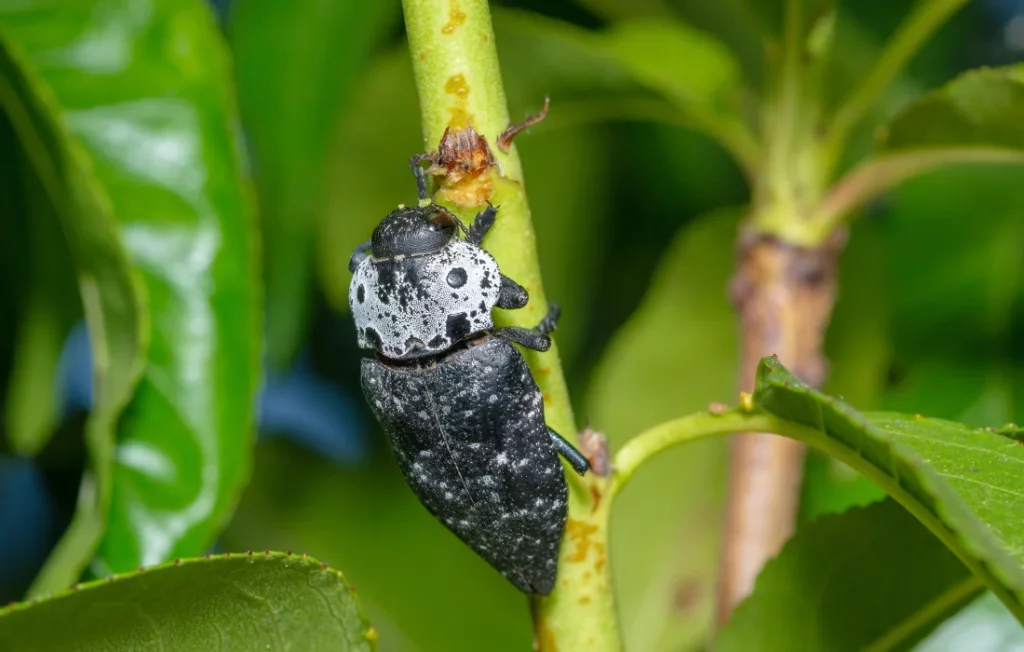
In fruit growing, the Mediterranean flatheaded root borer ( Capnodis tenebrionis ) is rightly feared: this major pest of stone fruit trees attacks the root system. Apricot, peach, plum, and cherry trees can decline rapidly, often without initially showing any visible symptoms, ultimately causing significant economic losses. How can you identify the damage? And what control measures should you take? Our advice and solutions.
Description of the peach tree capnode
The Mediterranean flatheaded root borer ( Capnodis tenebrionis) is a beetle in the family Buprestidae .
The adult capnod wasp is recognizable by its stocky build and the hardness of its elytra. Its dark coloration, sometimes tinged with ash-grey highlights, makes it very inconspicuous both on the ground and on tree trunks. Notable observations include:
- a size between 15 and 25 mm ,
- a marked difference between the sexes , with females being larger than males,
- an adult population composed mainly of females , at around 90%.
This high proportion of females partly explains the potential for rapid colonization observed in some plots.
Capnode larvae are white, legless, with powerful black mandibles adapted for boring into woody tissue. At the end of their development, they can reach up to 6.5 cm in length .
What are the host plants?
The Mediterranean flatheaded root borer primarily attacks stone fruit trees, with a marked affinity for certain species cultivated in orchards. The most frequently affected hosts are:
- the peach tree ,
- the plum tree ,
- the apricot tree ,
- the almond tree .
Beyond these species, all stone fruit trees can serve as host plants, which greatly broadens the spectrum of risk in fruit tree cultivation.
Young trees , whose root systems are still underdeveloped, are particularly vulnerable. Weakened trees or those under stress , especially water stress, are also more susceptible, as the larvae take advantage of this fragility to establish themselves permanently.
Do you need a natural solution against the Mediterranean flatheaded root borer ?
What damage is caused by the Mediterranean flatheaded root borer?
The Mediterranean flatheaded root borer is distinguished by the diversity of organs it can affect during its life cycle. Depending on the stage of development, attacks affect the roots, the collar, the trunk, the branches, the buds, the leaves, the flowers and the fruits.
Adults cause damage primarily to the air, visible on the foliage and young shoots. Specifically observed are:
- the partial consumption of the leaves ,
- the presence of petioles lacking a limb ,
- the falling to the ground of still-green leaves ,
- the gnawing of the bark on young branches .
The larvae represent the most damaging stage. By attacking the underground parts, they directly compromise the tree’s survival. Their actions lead to:
- deep attacks on the roots and the collar ,
- the severing of the sap-conducting vessels ,
- a disruption of the water and nutrient supply ,
- a gradual , often irreversible decline,
- a high risk of mortality , especially in young trees.
Life cycle of Capnodis tenebrionis
The Mediterranean flatheaded root borer has a long life cycle , spanning several years. Generations overlap , and several larval stages can coexist simultaneously on the same tree, making population dynamics complex.
Adults emerge mainly in spring . Their activity is then concentrated in spring and summer , periods during which they move, feed and reproduce.
The lifespan of females varies greatly depending on their emergence period:
- Females that emerge in May generally live for 2 to 4 months .
- Those appearing in July-August can survive up to 15 months .
They have the ability to hibernate in or near the orchard, allowing them to lay eggs the following spring.
Each female lays an average of about 100 eggs . Eggs are laid at the base of the tree or directly on the ground, within a radius of approximately 60 cm around the trunk. Incubation lasts from 10 to 20 days, depending on temperature conditions.
After hatching, the young larvae quickly penetrate the soil. They target roots located between 10 and 25 cm deep , where they begin their development by feeding on the woody tissues.
At the end of its growth, the larva moves up towards the base of the tree and digs a chamber of about 3 cm . The pupal stage lasts about a month , at the end of which a new adult is formed, ready to emerge when conditions become favorable.e loge d’environ 3 cm. La nymphose dure environ un mois, à l’issue duquel un nouvel adulte est formé, prêt à émerger lorsque les conditions deviennent favorables.
Agrobiotop solutions for controlling the Mediterranean flatheaded root borer
We develop natural solutions to combat this wood-boring insect.
As a physical barrier:
For application to the entire fruit tree from spring/summer onwards.
Apply every 21 days if necessary.
Application rate:
CHITOPROTECT 1.5L + 3kg BENTOBIO / 300L of water / hectare;
CHITOPROTECT 2L + 4 to 6 kg BENTOBIO / 800L of water / hectare
Do not hesitate to contact us for more information on the protocol to apply against this pest.
Other pests of fruit trees: