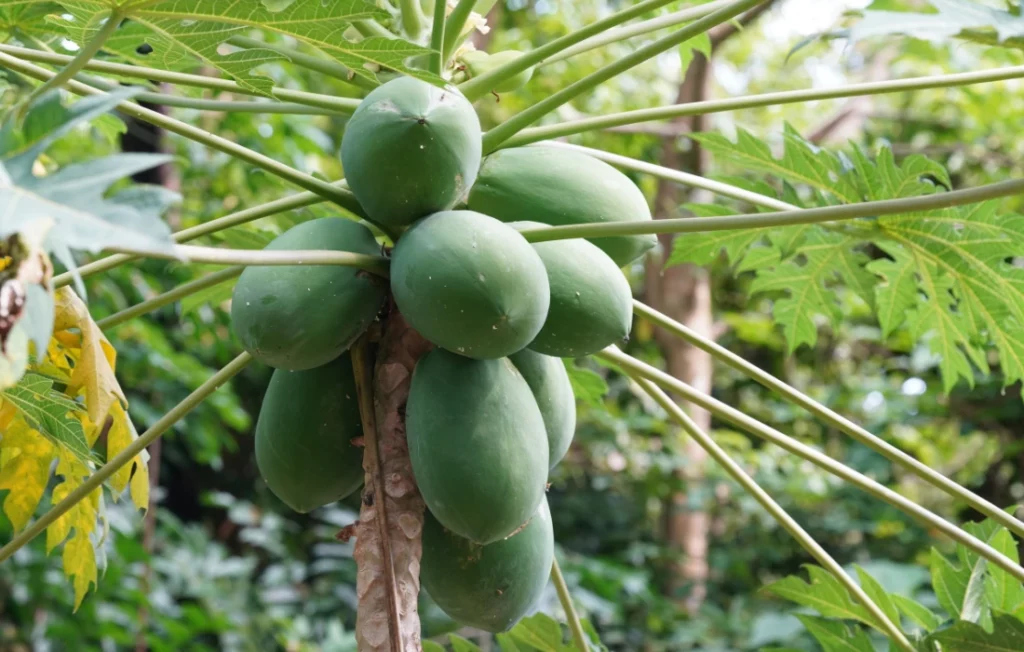
Papaya is a crop susceptible to numerous health imbalances, particularly in tropical and subtropical climates. Papaya diseases can quickly compromise plant vigor, fruit quality, and consistent harvests. How can you identify these diseases? Agrobiotop, an expert in agrobiology, helps you identify each disease and adopt the right control solutions.
- Papaya powdery mildew (Oidium caricae )
- Papaya anthracnose ( Colletotrichum gloeosporioides )
- Black spot disease of papaya ( Asperisporium caricae )
- Papaya Sigatoka ( Cercospora papayae )
- Papaya brown spot disease ( Corynespora cassiicola )
- Crown and root rot of papaya (Phytophthora spp.)
- Papaya bacteriosis (Erwinia papayae)
- Papaya ringspot virus (PRSV)
- Papaya leaf curl virus (PaLCuV)
- Agrobiotop solutions for controlling papaya diseases
Papaya powdery mildew (Oidium caricae )
Powdery mildew of papaya is caused by a fungus of the Erysiphaceae family, which thrives in warm weather with high relative humidity. It primarily attacks young leaves, where pale yellow patches appear on the upper surface, while a whitish to grayish down forms along the veins on the underside. Gradually, the leaves become deformed, curl, and then fall off. On the fruit, the disease manifests as superficial grayish-brown spots with a corky appearance, which can leave visible scars at maturity and impair commercial appearance.
Papaya anthracnose ( Colletotrichum gloeosporioides )
Anthracnose is a fungal disease favored by warm, humid conditions, common in tropical regions. The fungus primarily infects fruit, causing circular, blackish spots that gradually penetrate the pulp, leading to browning and then localized rot. The pathogen can remain dormant on green fruit and suddenly manifest at ripening or after harvest. On leaves, small black spots develop into perforations in the leaf blade, while on stems and young branches, the infection can lead to progressive dieback of the tips.
Black spot disease of papaya ( Asperisporium caricae )
Black spot disease is caused by a fungus widespread in tropical regions. It primarily affects older leaves, on which numerous small, brownish-gray spots appear, surrounded by a yellow halo. These lesions are accompanied, on the underside, by blackish pustules rich in spores. The accumulation of infections leads to generalized yellowing and premature leaf drop, weakening the papaya tree. On the fruit, the symptoms remain on the surface, appearing as small, light brown spots with black centers, which degrade the appearance without affecting the flesh.
Do you need expertise and solutions for your papaya crops?
Papaya Sigatoka ( Cercospora papayae )
Cercospora leaf spot of papaya is caused by a fungus that thrives mainly in humid conditions and on dense foliage. The first signs appear on the oldest leaves, with irregular grayish to light brown lesions that may merge. When disease pressure is high, the leaves yellow, become necrotic, and then fall off, reducing the photosynthetic surface area. The fruit may also develop small blackish spots, barely visible when green but clearly marked at maturity, resulting in a visual defect without internal rot.
Papaya brown spot disease ( Corynespora cassiicola )
Target spot , also known as brown spot disease , is caused by a fungus that thrives in warm, humid conditions. On papaya trees, it primarily affects older leaves, where angular brown spots appear. These spots develop into lesions with a pale gray center, bordered in dark brown and often ringed with yellow. Over time, the necrotic tissue may fall off, leaving characteristic perforations in the leaf blade. In conditions favorable to the fungus, the spots enlarge, become concentric, and can merge, causing significant defoliation that reduces the tree’s vigor. The fruit is less frequently affected, sometimes with superficial concave spots appearing in very humid environments.
Crown and root rot of papaya (Phytophthora spp.)
Crown and root rot is caused by oomycetes of the genus Phytophthora , formidable agents in waterlogged or poorly drained soils. The infection usually begins at the roots and base of the trunk, where a dark brown, wet rot develops. The root system deteriorates, leading to progressive yellowing of the foliage, followed by sudden wilting of the young leaves at the top. The papaya tree then appears to dry out rapidly before a general decline. Necrosis may also appear on the trunk, causing fruit drop above the affected areas, while fruit near the ground may develop a brown rot accompanied by a whitish, felt-like growth.
Papaya bacteriosis (Erwinia papayae)
Bacterial blight of papaya is a serious disease caused by Erwinia papayae , primarily affecting the above-ground parts of the plant. The first signs often appear at the apical crown, with soggy, dark areas at the base of the petioles, followed by yellowing and then necrosis of the leaves. Young leaves wilt, apex growth stops, and the petioles soften and curl downwards. On the stems, moist lesions turn black and may release a sticky exudate, indicating internal tissue degradation. The fruit develops brown spots associated with watery softening of the flesh, and young fruit drops rapidly as the infection progresses.
Papaya ringspot virus (PRSV)
Papaya ringspot virus is one of the most damaging diseases of papaya worldwide. Transmitted by aphids, it spreads rapidly within plantations. On the leaves, it causes yellow-green mottling, vein lightening, and severe deformation of the young leaf blades, which become narrow, wrinkled, and irregular. Tree growth is severely stunted, and the overall form remains weak. Dark green streaks appear on the petioles and trunk, while the fruit develops characteristic ring spots in concentric circles. These fruits remain small, ripen poorly, and lose all commercial value, even leading to a complete halt in production during severe infestations.
Papaya leaf curl virus (PaLCuV)
Leaf curl disease is caused by a DNA virus transmitted primarily by whiteflies, including Bemisia tabaci , which are very common in tropical regions. Once introduced into the plant, the virus severely disrupts leaf tissue function and overall growth. The leaves quickly become curled downwards, with thickened, yellowish veins, accompanied by light to dark green mottling. The foliage becomes rigid, deformed, and small. Throughout the plant, the internodes shorten, the growth habit becomes compact and disorganized, and the papaya tree remains stunted. Fruit production is then greatly reduced, or even nonexistent, making the disease particularly detrimental to cultivation.
Agrobiotop solutions for controlling papaya diseases
Soil improvement (Input of organic matter recommended)
- SILIBOOST : (Activated Silica SiO3) A very important element on tropical crops such as papaya, allowing for the improvement of the structures of moist soils, thus preventing water stagnation which is conducive to the development of diseases (rot, phytophthora, Fusarium wilt, Pythium).
Papaya cultivation: plant diseases, fruit diseases before and after harvest
- BENTOBIO : natural sodium bentonite clay .
Sodium bentonite clay is a natural and organic mineral that strengthens plant defenses and helps fight against many diseases and pests that affect pineapple cultivation.
This mineral clay has a strong absorption capacity, allowing you to strengthen the defenses of your plants and has a fungistatic and healing action against fungal diseases that affect papaya crops.
Rich in smectite (montmorillonite), it is used both preventively and curatively because it protects and strengthens plant cell tissue, creating an environment unfavorable to the establishment of pathogenic fungi and pests. BENTOBIO also demonstrates its effectiveness against brown spot disease, anthracnose, rot, bacterial diseases, etc. It also has a mechanical action against various insect pests of papaya trees (whiteflies, aphids, mites).
This natural solution is an alternative to synthetic solutions; it comes in concentrated powder form. BENTOBIO can be used as a powder or foliar spray.
When mixed with CHITOPROTECT (chitosan) to combat various diseases and insects, they prove to be an indispensable solution for fighting diseases and pests.
- CHITOPROTECT : ( Food-grade animal-derived chitosan ) or CHITOPROTECT CHITOSANE ( Chitosan of Aspergillus niger origin )
Elicitor, activates the plant defense system, natural polymer creating a protective biofilm. Fungistatic and bacteriostatic action.
Papaya cultivation is a tropical crop that is very sensitive to humidity and fungal diseases; this solution used in cultivation practices is applied both preventively and curatively.
BENTOBIO + CHITOPROTECT is primarily known for its adsorption, water retention, and physical barrier properties. It is widely used in agriculture, but its direct application against crop diseases relies on its preventative and curative effects, or its support of plant health through the provision of trace elements, including iron. The combination of the two solutions is applied as a foliar spray to form a protective layer on leaves, stems, or fruit. This reduces and eradicates the germination of spores, mycelium, and oospores by limiting their contact with the leaf surface. It also reduces sunburn, which can weaken crops and facilitate pathogen entry.
Uses – Indicative doses depending on the equipment used : Consult us. The recommended doses may vary depending on the application method, whether by air (airplane) or drone.
To this solution, biostimulant products can be added for a complementary action (indirect action on pests, physical barrier):
Action against papaya pests
Papaya pests include: Whiteflies, scale insects, leafhoppers, aphids, thrips, mites, psyllids.
Physical barrier effect, sprayed as a suspension: mixture of CHITOPROTECT (food-grade crustacean chitosan or Aspergillus niger) + BENTOBIO (sodium bentonite clay). The solution forms a natural biofilm that disrupts insect feeding by preventing them from taking food and damaging their mouthparts. It prevents stings or bites, thus preventing the spread of viruses in some cases, as well as insect egg-laying.
The texture of both products hinders movement, especially on larvae (scale insects), and disorients the insects. It acts as a mechanical repellent against pests. The leaves are less attractive to insects (less shine, fewer volatile odors released). Example on the pear sawfly . It does not block plant photosynthesis. No toxic effect for the user.
Do not hesitate to contact us for more information on the protocol to apply against this pest.
Other diseases of tropical crops:
Photo : Shutterstock