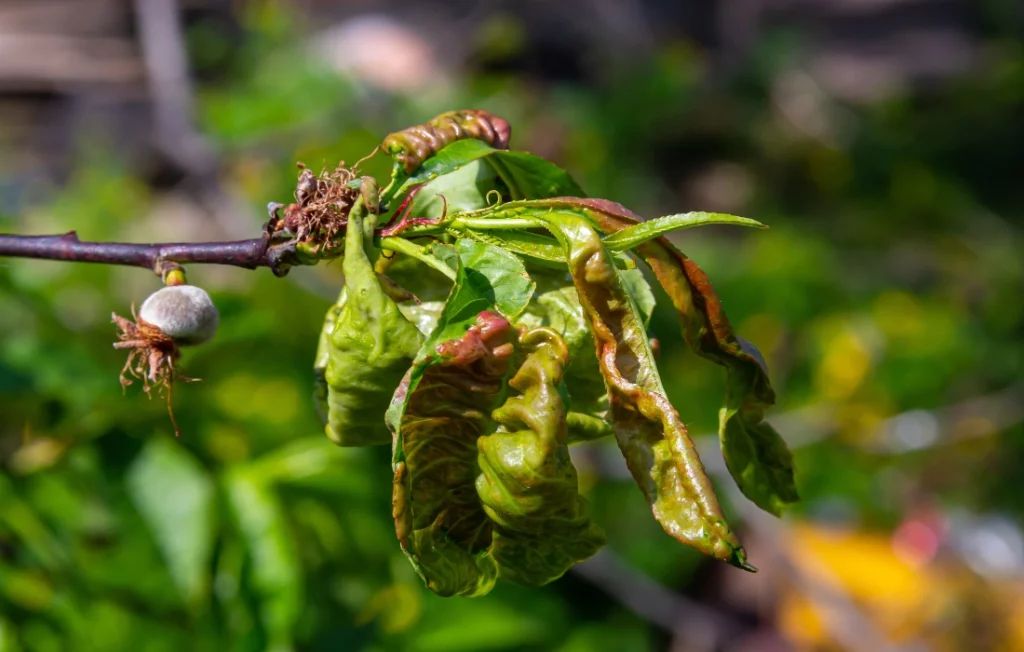
Peach tree diseases often appear faster than expected: a wet spring, a dry summer, a weakened tree… and the orchard’s balance is disrupted. Leaf curl, brown rot, shot-hole disease, or trunk diseases: numerous fungal and bacterial diseases affect this fruit tree. As experts in organic farming, Agrobiotop helps you better identify these diseases and offers natural solutions suitable for organic agriculture.
- Peach leaf curl ( aphrina deformans )
- Moniliosis (Monilia laxa )
- Peach scab (Venturia carpophila )
- Peach powdery mildew ( Sphaerotheca pannosa var. persica)
- Peach tree shot-hole disease (Coryneum )
- Peach canker / Decline
- Peach parasitic lead (Stereum purpureum )
- Sharka (Plum Pox Virus )
- Bacterial spots on stone fruit trees
- Agrobiotop solutions against peach diseases
Peach leaf curl ( aphrina deformans )
Leaf curl is probably the most emblematic disease of peach trees. It appears as soon as new growth begins and quickly transforms the foliage into a mass of swollen, thickened, and twisted leaves. This visual upheaval results from a profound disruption of leaf metabolism: the tissues swell, become deformed, and then gradually change color, turning from yellow to red. The leaves eventually dry out, become brittle, and fall prematurely.
When the attack is severe, the young branches can also become deformed, giving the tree a weakened appearance from spring onwards.
The conditions that favor its establishment often rely on a succession of mild days followed by colder episodes.
A persistent leaf curl weakens the peach tree permanently: loss of leaf surface area, reduced photosynthesis, slowed growth and impacted harvest.
Moniliosis (Monilia laxa )
Moniliosis typically accompanies mild, wet springs , when peach blossoms become the ideal entry point for the fungus. The inflorescences dry out abruptly, as do the tips of the branches that bear them. The tree then displays its characteristic withered clusters, sometimes accompanied by gummosis or cankers forming at the base of the dead tissue.
As the fruit develops, the disease can progress to a soft brown rot, marked by concentric circles of whitish pads. Affected peaches fall before ripening or remain hanging as mummified fruit.
Moniliosis compromises flowering, fruit set and the final quality of the fruit.
Peach scab (Venturia carpophila )
Peach scab is most prevalent during wet springs, when the fungus finds ideal conditions to infect young tissues. The first signs appear on the fruit as small brown spots , as if the skin had been slightly punctured. These marks remain superficial at first, but they gradually harden the skin, disrupting the normal growth of the peaches.
When the tree then goes through a period of drought followed by heavy rains, the fruit becomes particularly vulnerable: the skin, having become rigid, can no longer accommodate the increase in volume. It then cracks , creating fissures that are sometimes deep and severely degrade the quality of the harvest.
Although scab primarily affects the fruit, the leaves can also show dark spots of varying sizes. All of these symptoms reduce production and can compromise some of the fruit set.
Do you need a natural solution against peach tree diseases?
Peach powdery mildew ( Sphaerotheca pannosa var. persica)
Powdery mildew mainly appears when heat and drought set in. The pathogen develops on the surface of the tissues and forms a white, powdery coating that is particularly visible on the undersides of the leaves. The leaves eventually become deformed, blistered, and sometimes curled.
Young shoots are not spared: their growth becomes twisted, their tissues fragile, and their elongation disrupted. The fruit may also show signs of infection, affecting its appearance and development.
Although less dramatic than leaf curl, powdery mildew gradually weakens the tree, reducing its overall vigor and fruiting potential.
Peach tree shot-hole disease (Coryneum )
Shot-hole disease is aptly named: it transforms leaves into veritable perforated pieces , as if they had been struck by fine, burning drops. It all begins with the appearance of small red to purplish spots, which darken and then detach, leaving small, regular holes.
As the attack intensifies, the leaves yellow and then fall, sometimes resulting in significant defoliation. Gummosis frequently appears on affected branches, a sign that the tree is attempting to insulate the damaged tissues.
This disease weakens the peach tree especially at the beginning of the season, a period when the leaf surface area plays a major role in building up reserves.
Peach canker / Decline
(Pseudomonas, Fusicoccum, Cystospora)
Canker is not a single disease, but a group of attacks caused by different pathogens capable of progressively destroying tissue. These agents secrete toxins that lead to necrosis of plant organs: twigs, young shoots, and sometimes parts of the trunk.
The first signs include yellowing leaves , partially drying branches, and slowed growth. Gradually, the tree loses its ability to photosynthesize properly, and its shape deteriorates.
When cankers spread, the peach tree can enter an advanced state of decline. Sap flow decreases, branches die one after another, and the tree’s short-term survival is compromised.
Peach parasitic lead (Stereum purpureum )
This vascular disease is dreaded because it progresses slowly, but always in the same direction: the complete decline of the tree. The fungus can colonize deep into the wood, sometimes reaching the roots. Its development follows three main stages:
- appearance of pale green leaves , with a metallic or milky sheen at the beginning of the growing season;
- leaves that curl up , rolling into a gutter shape;
- reduced leaves , grouped on flattened branches, giving a very characteristic appearance.
Once these signs are firmly established, the peach tree’s growth stops. The tree generally declines within two or three years.
Sharka (Plum Pox Virus )
Sharka is among the most feared viral diseases affecting stone fruit trees. It is transmitted by aphids and contaminated plant material.
The first symptoms are sometimes visible on the petals, with the presence of purplish streaks . On the leaves, discoloration appears along the veins, creating more or less pronounced mottling . The fruits, meanwhile, develop typical chlorotic rings that severely alter their appearance and diminish their flavor.
Sharka jeopardizes the marketing of peaches, but above all the sustainability of orchards, because it spreads silently and affects both the most vigorous and the most fragile trees.
Bacterial spots on stone fruit trees
Discreet in some years, very visible in others, this disease often appears after wet springs. The bacteria overwinters in cankers or probably in buds, then reactivates as soon as conditions improve.
The leaves initially show small red spots , often located near the veins or at the tips. Part of the leaf blade eventually becomes necrotic and falls off, sometimes leaving gaps. The foliage then thins out, and the tree loses some of its growth capacity.
The fruit can be affected as early as the end of June: small, brownish, circular depressions appear, sometimes accompanied by gum exudation. These lesions can severely degrade the visual quality of the peaches.
Agrobiotop solutions against peach diseases
Soil improvement (aeration, oxygenation and decompaction): indirect action on the peach tree diseases described above
For action on peach diseases
- CHITOPROTECT (chitosan)
- BENTOBIO
- YAKAPRO
We have comprehensive programs for applying AGROBIOTOP solutions to peach and apricot trees. Please feel free to contact us for more information .