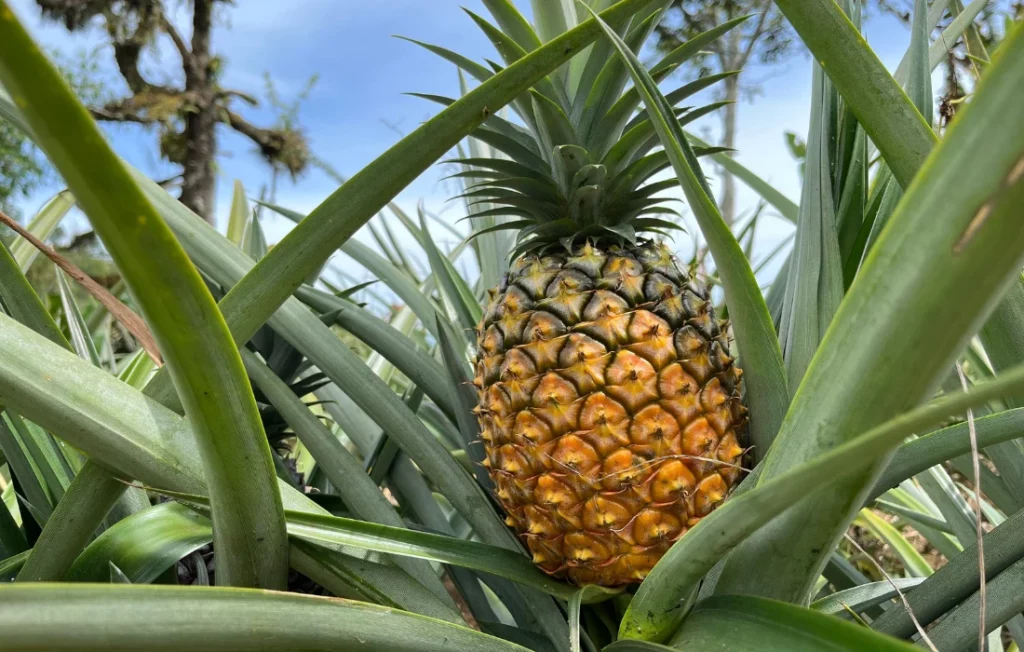
Pineapple is a tropical crop with high economic value, but it is susceptible to numerous diseases. Soil fungi, bacteria, and physiological imbalances easily find favorable conditions in intensive or poorly drained production systems. Identifying the main pineapple diseases, their characteristic symptoms, and the factors that promote them allows for more precise adjustments to cultivation practices, helps anticipate losses, and ensures the long-term viability of plots, both in conventional agriculture and in more agroecological systems.
- Pineapple wilt disease (scale insect-associated dieback)
- Heart rot (Dickeya zeae)
- Phytophthora heart rot
- Black rot of pineapple (Chalara paradoxa)
- Fusarium of pineapple ( Fusarium guttiforme )
- Black spot disease
- Pineapple pink disease (Pantoea citrea )
- Yeast rot of pineapple (Hanseniaspora, Pichia and Candida )
- Agrobiotop solutions for controlling pineapple diseases
Pineapple wilt disease (scale insect-associated dieback)
This disease is based on a close interaction between viruses of the genus Ampelovirus , mealybugs (Dysmicoccus spp.), and the ants that protect and spread them. The viruses involved, primarily Pineapple mealybug wilt-associated viruses (PMWaV-1 and PMWaV-2), are transmitted when the mealybugs feed on the sap. Infestations are favored by warm conditions and a low level of biological control.
The first symptoms appear as reddening at the base of the leaves , followed by loss of rigidity, downward curling, and necrosis of the tips . Growth slows considerably, the plant takes on a wilted appearance, and in advanced cases, it either fails to bear fruit or produces small, misshapen fruit.
Heart rot (Dickeya zeae)
This disease is caused by the bacterium Dickeya zeae , a pathogen capable of surviving in plant debris and decaying fruit juices. Contamination most often occurs during flowering, when the bacterium enters through floral tissues, carried by insects or spread by rain and wind. Wounds on the plants facilitate infection, especially in warm, humid climates. The first signs appear in the center of the rosette, with water-soaked lesions at the base of young leaves , which quickly progress to soft rot accompanied by gas blisters. When the fruit is affected, frothy ooze and internal fermentation lead to a dramatic collapse of the flesh, leaving an empty shell with a strong odor of decay.
Phytophthora heart rot
This disease is caused by soilborne oomycetes, primarily Phytophthora cinnamomi and Phytophthora nicotianae , which can persist for extended periods as resistant spores. Poorly drained, waterlogged soils or those subjected to heavy rainfall create favorable conditions for the release of motile zoospores that infect the roots and growing point. Young plants are particularly susceptible. Symptoms begin with discoloration of the central leaves , which turn yellow or brown before wilting and dying. The heartwood becomes soft, waterlogged, and foul-smelling , and affected leaves detach easily. Upon cutting, a well-defined, yellowish-brown rot appears at the meristem, rapidly progressing to complete plant destruction if waterlogging persists.
Do you need expertise and solutions for your pineapple crops?
Black rot of pineapple (Chalara paradoxa)
Black rot is caused by the fungus Chalara paradoxa , which can infect both fruit and planting material. The disease develops primarily in hot, humid climates, when the fungus enters through bark wounds, rain-induced cracks, or peduncle damage during harvest. On the fruit, the first signs are a watery rot of the flesh, with a translucent skin that turns brown and then black, becoming brittle. The deterioration progresses rapidly until the fruit completely disintegrates, leaving only a blackened, fibrous shell. On infected crowns and suckers, the pathogen causes collar rot: the basal tissues blacken, disintegrate, and lead to poor root development or rapid decline of young plants.
Fusarium of pineapple ( Fusarium guttiforme )
Fusarium wilt is primarily caused by the soilborne fungus Fusarium guttiforme , the expression of which is highly dependent on varietal susceptibility and climatic conditions during flowering and fruit development. The pathogen is spread by air, rain, and insects, and most often enters through wounds on the inflorescence or young fruit. Affected plants exhibit stunted growth with an abnormal rosette habit , characterized by short, deformed central leaves. The fruit develops brown lesions at the base of the eyes, accompanied by visible gummy exudates on the surface. These eyes cease to grow, resulting in bumpy, malformed fruit with browned flesh beneath the affected areas.
Black spot disease
Black spot is an internal fruit rot caused by a complex of fungi, including Fusarium and Talaromyces stollii species . Infection occurs very early, at flowering time, when the pathogens colonize the open flowers, often without visible symptoms during fruit development. The fungi remain dormant until ripening. When the pineapple opens, brown necrosis appears inside some fruitlets, initially as translucent areas, then as well-defined dark brown to black spots. The rot remains dry and confined to each eye, rendering the fruit inedible despite a sometimes healthy external appearance, which explains the significant losses observed after harvest.
Pineapple pink disease (Pantoea citrea )
Pink disease is caused by bacteria, primarily Pantoea citrea , which infect fruit during flowering when the blossoms are open. Infection is favored by a typical climatic sequence, with a dry period before flowering followed by cool, wet weather, and by the passage of insects and mites that carry the bacteria from contaminated fruit or crop residue. The bacteria colonize the fruit flesh without causing any visible signs in the field. Affected fruit appears healthy externally, but sometimes has slightly translucent, pinkish flesh and a faint, sweetish odor. The symptom becomes apparent during industrial heating: the pulp then turns bright pink, red, or dark brown, rendering the batches unsuitable for processing.
Yeast rot of pineapple (Hanseniaspora, Pichia and Candida )
Yeast rot is a post-harvest disorder caused by several fermentative yeasts, including Hanseniaspora , Pichia, and Candida , which enter the fruit through cracks or wounds in the peel. It primarily affects very ripe, damaged, or improperly stored pineapples under warm and humid conditions. Once established, the yeasts rapidly ferment the sugars in the flesh. Affected fruit releases a frothy juice rich in gas bubbles, emits a characteristic alcoholic odor , and has soft, spongy flesh saturated with fermented liquid. In advanced stages, only a dark brown, dried, and fibrous shell remains, indicating complete fruit spoilage.
Agrobiotop solutions for controlling pineapple diseases
Soil improvement
- SILIBOOST : (Activated Silica SiO3) A very important element on tropical crops, allowing the improvement of the structures of moist soils, thus preventing water stagnation which is conducive to the development of diseases (rot, phytophthora, Fusarium, Pythium).
Pineapple cultivation: plant and fruit diseases before and after harvest
- BENTOBIO : natural sodium bentonite clay .
Natural and organic mineral, sodium bentonite clay strengthens plant defenses and helps fight against many diseases and pests that affect pineapple cultivation.
Sodium bentonite clay is a mineral clay with a strong absorption capacity. It helps strengthen the defenses of your plants and has a fungistatic and healing action against fungal diseases that affect pineapple crops.
Rich in smectite (montmorillonite), it is used both preventively and curatively because it protects and strengthens plant cell tissue, creating an environment unfavorable to the establishment of pathogenic fungi and pests. BENTOBIO also demonstrates its effectiveness against black spot (Penicillium), pythium, botrytis, Fusarium, etc. It also has a mechanical action against various insect pests of pineapple (scale insects, mites).
This natural solution is an alternative to synthetic solutions and comes in concentrated powder form. BENTOBIO can be used as a dusting or foliar spray. When mixed with CHITOPROTECT (chitosan) to combat various diseases and insects, it proves to be an essential solution for pest and disease control.
- CHITOPROTECT : (Food-grade animal-derived chitosan) or CHITOPROTECT CHITOSANE (Chitosan from Aspergillus niger)
Elicitor, activates the plant defense system, natural polymer creating a protective biofilm. Fungistatic and bacteriostatic action.
Pineapple cultivation is a tropical crop that is very sensitive to humidity and fungal diseases; this solution used in cultivation practices is applied both preventively and curatively.
BENTOBIO + CHITOPROTECT is primarily known for its adsorption, water retention, and physical barrier properties. It is widely used in agriculture, but its direct application against crop diseases relies on its preventative and curative effects, or its support of plant health through the provision of trace elements, including iron. The combination of the two solutions is applied as a foliar spray to form a protective layer on leaves, stems, or fruit. This reduces and eradicates the germination of spores, mycelium, and oospores by limiting their contact with the leaf surface. It also reduces sunburn, which can weaken crops and facilitate pathogen entry.
Soaking of cuttings :
CHITOPROTECT + BENTOBIO. Promotes better root development , making plants more resistant to root diseases (Phytophthora, rot, Fusarium wilt). Pre-soak cuttings in the solution.
Does not interfere with plant photosynthesis. No toxic effects for the user.
Uses – Indicative doses depending on the equipment used : Consult us. The recommended doses may vary depending on the application method, whether by air (airplane) or drone.
To this solution, biostimulant products can be added for a complementary action (indirect action on pests, physical barrier):
Action against pineapple pests
Pineapple pests include: scale insects, leafhoppers, aphids, thrips, mites, psyllids.
Physical barrier effect, sprayed as a suspension: mixture of CHITOPROTECT (food-grade crustacean chitosan or Aspergillus niger) + BENTOBIO (sodium bentonite clay). The solution forms a natural biofilm that disrupts insect feeding by preventing them from taking food and damaging their mouthparts. It prevents stings or bites, thus preventing the spread of viruses in some cases, as well as insect egg-laying.
The texture of both products hinders movement, especially on larvae (scale insects), and disorients the insects. It acts as a mechanical repellent against pests. The leaves are less attractive to insects (less shine, fewer volatile odors released). Example on the pear seafly. It does not block plant photosynthesis. No toxic effect for the user.
Do not hesitate to contact us for more information on the protocol to apply against this pest.
Other diseases of tropical crops:
- Banana plant diseases
- Kiwi diseases
- Papaya diseases
- Diseases of the mandarin tree
Photo : Shutterstock