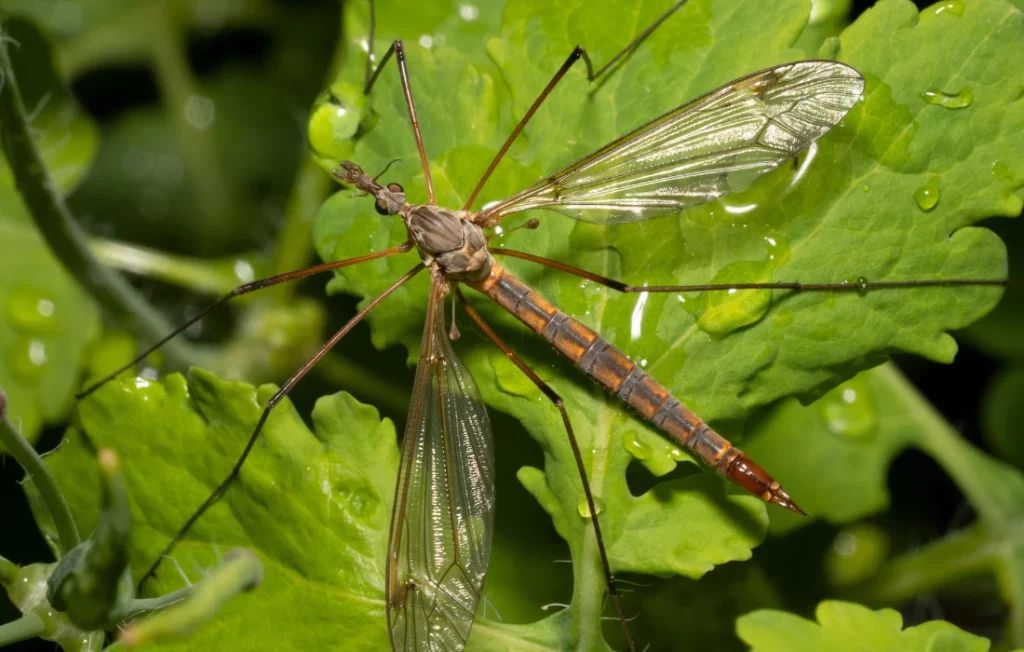
Crane flies can become a real problem when they infest fields, golf greens, and meadows, especially in damp soils. Their larvae, active from winter onwards, weaken young crops, causing visible losses as soon as they emerge. To support farmers facing these situations, Agrobiotop has developed natural solutions suitable for organic farming to limit larval pressure and ensure successful establishment of meadows, cereals, and vegetable crops.
Description of crane flies
Crane flies are frequently mistaken for large mosquitoes, but their morphology and role in the ecosystem are very different. These insects belong to the order Diptera. Two species dominate in agricultural fields: Tipula paludosa and Tipula oleracea . Both are widespread in France, although they thrive in more favorable areas, particularly in wetlands.
Adults
Adults cause no damage to crops. Their slender, elongated bodies resemble those of giant mosquitoes, but they do not bite. Length varies according to sex and species: males reach 16 to 18 mm, females 19 to 25 mm. Their small, rounded heads bear antennae composed of 13 segments. Those of males are longer, providing a clear visual difference. The long, slightly milky wings have a brownish border. At rest, they fold roof-like. The very long, thin legs break easily during capture or flight.
In fields, meadows and lawns, adults are most visible in wet areas, meadows, marshes or after heavy rain. They fly mainly in the morning and late afternoon.
Eggs
Reproduction is particularly prolific: a female can lay between 300 and 400 eggs on the ground, whether in flight or while walking. The eggs, black and rigid, measure around 1 mm. Their development requires very moist soil, close to saturation. They are found mainly in meadows, areas rich in weeds, or organic soils favorable to the survival of young larvae.
Larvae
The larvae are the only potentially damaging stage. Legless and earthy-grey in color, they can reach 3 to 4 cm in length at the final instar. Their soft, cylindrical body is capable of rapidly contracting or elongating. Several characteristics allow them to be distinguished from other soil pests:
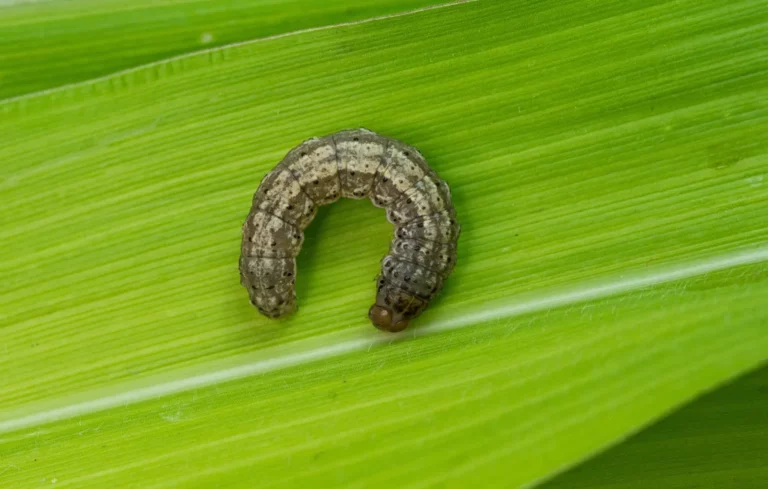
- They never curl up, unlike cutworms
- The head is retractable, giving it a thick and segmented appearance.
Highly resistant to cold, they continue their development even in winter without entering a biological dormancy. The young larva, present from the beginning of winter, measures approximately 1.5 mm.
Conditions that promote infestations
Crane flies particularly favor damp environments . Regular rainfall, waterlogged areas, permanent grasslands, and soils rich in organic matter all encourage larval settlement. The risk increases significantly after pasture conversion, when crop rotation includes forage crops, or when fields remain grassy for extended periods. In these conditions, egg-laying is easier, egg survival is improved, and larvae find a diverse food source.
Do you need a natural solution against crane fly larvae?
What crops are targeted by crane flies?
Crane flies feed on organic matter and can attack a wide variety of cultivated species when young tissues are tender and accessible. The larvae are found on numerous host plants, including:
- grasses
- permanent and temporary grasslands
- winter cereals (wheat, barley) and spring cereals
- Vegetables : cabbage, onions, shallots, lettuce, beans, peas, potatoes
In market gardening, damage can affect recently planted rows, especially when the soil remains damp. In arable farming, cereal plots planted after pasture are often the most vulnerable.
On corn , infestations do occur but remain rare. The larvae prefer surface organic debris to the living tissues of the corn. Observed symptoms are generally mild: irregularly cut leaves, slightly damaged horns, or leaves buried by burrowing activity. In most cases, corn growth is unaffected.
What are the symptoms of a crane fly infestation?
The damage caused by crane flies depends heavily on the stage of plant development and the larval density. Young seedlings are the most vulnerable.
- Meadows and golf greens : the larvae cut the stems at the base, creating patches of dead vegetation. The clumps turn yellow and then thin out. In newly sown meadows, the vulnerability is even greater: the above-ground parts of the seedlings are eaten when they are only 1 to 2 cm tall, sometimes leading to the complete disappearance of entire rows.
- Cereals : Winter cereals can be attacked as early as December. The larvae sever the bases of the stems, causing yellowing, weakening, and sometimes death of the plants. In spring cereals, the larvae find germinating seeds very early, which exacerbates losses starting in January. The peak of the damage often occurs in spring, when larval activity reaches its maximum.
- Vegetables : Vegetables with tender stems or planted in damp soil are more susceptible. Young shoots are attacked underground, which can stunt growth.
For potatoes, the larvae primarily target young stems, but the damage remains minor compared to other pests.
Agrobiotop solutions against crane flies
Soil improver :
Oxygenation, aeration and decompaction help prevent water from stagnating in the soil.
Direct action on crane flies:
Application rate after rain or watering: 10L/100L of water/hectare,
25L/300L of water/hectare (golf green)
Seed coating, soaking or spraying : protection against crane flies, repellent effect
Feel free to contact us for more information.
Crane fly life cycle
The two species have a different cycle, which alters the period of risk for crops.
Tipula paludosa
This species has only one generation per year. It dominates in northern Europe and remains the most harmful in these regions.
Adults appear from July to September, peaking in late summer. Larvae are active from January, causing potential damage until May.
Tipula oleracea
Better adapted to temperate and mild climates, this species produces two generations per year. Adults fly in April and then again in October.
The second-generation larvae continue their development through the winter as soon as the weather permits, which increases the risk in winter crops.
Common points
The two species share several characteristics:
- Adults can mate multiple times
- The larvae primarily consume plant debris, but also attack living plants when resources become scarce.
- They dig tunnels that open to the surface, useful for coming up to feed during the night.
- The pupal stage remains buried in the ground and lasts for nearly three weeks.
Overall, the period of risk therefore depends heavily on climatic conditions: the milder the winter, the more larval activity is spread out.
Photo: Shutterstock