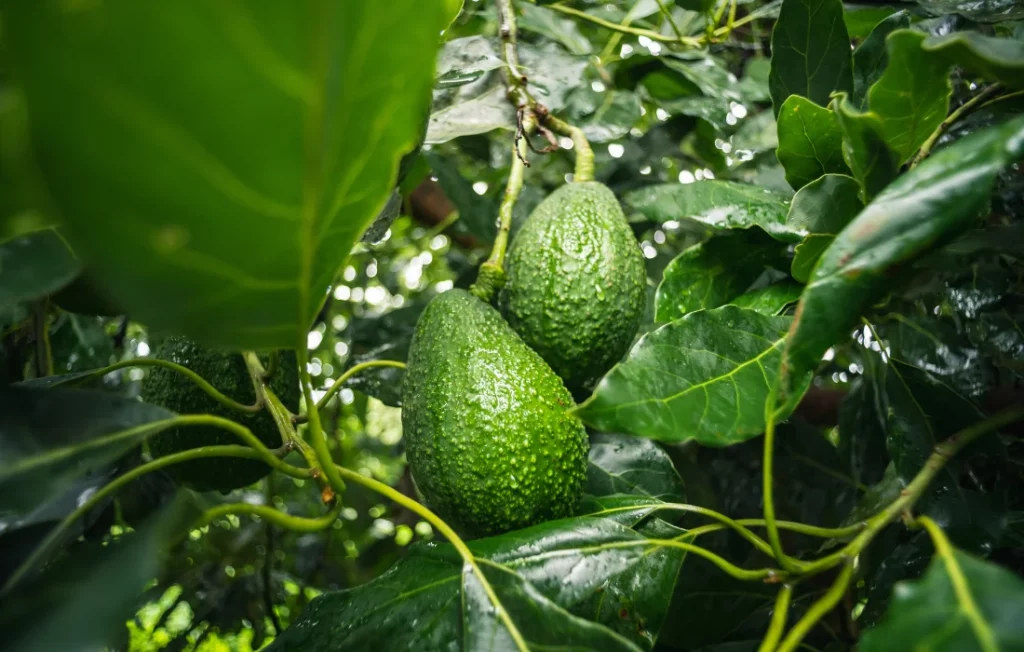
Avocado trees can be susceptible to several diseases that stunt their growth, damage leaves, weaken roots, or compromise fruit quality. When the first signs appear—spots, dieback, premature leaf drop, or bruised fruit—concerns quickly arise. Knowing how to identify the most common problems allows you to better assess the orchard’s health and identify at-risk situations. Here you will find information on the main avocado tree diseases, as well as our control solutions.
Phytophthora root rot
This is one of the most feared diseases in avocado orchards, as it directly attacks the fine roots, those responsible for absorbing water and nutrients. In the field, the most telling warning sign is the presence of necrotic feeder roots , accompanied by a progressive decline of the tree. The foliage loses density, growth slows, fruit production decreases, and overall vigor declines. In poorly drained plots, the damage can become very severe, with trees surviving but no longer producing adequately.
Initially, the avocado tree simply appears tired, less green, and less uniform in its growth. Then the symptoms become more pronounced, especially after periods of wet weather or in soils that retain too much water . This very strong link with the root environment makes it a major problem in production. When the soil remains saturated, the roots weaken, and the tree enters a vicious cycle from which it is difficult to escape.
Phytophthora canker on the trunk or collar
When Phytophthora is not limited to the roots, it can also affect the root collar and the base of the trunk . Dark cankers, sometimes accompanied by sap, are then observed on the lower parts of the tree. This type of infection can go unnoticed if the trunk is not closely inspected, even though it severely disrupts sap flow. Older trees are often more susceptible, especially when moisture remains at the base of the tree.
Impacts are observed on vigor, foliage strength, and the ability to support regular production. In some cases, branches gradually become bare, and then the tree declines in patches. In the field, a trunk that is repeatedly wet, soil that splashes easily, or poor aeration at the base can create conditions favorable to this disease.
Do you need expertise and solutions for your avocado crops?
Anthracnose
Anthracnose is best known for the damage it causes to fruit during ripening, often after harvest. This makes it particularly detrimental to marketing, storage, and export. Typical symptoms are sunken black spots on the skin , which then develop into salmon-colored to pinkish spore masses in the affected areas. A fruit that appeared healthy at harvest may therefore reveal the disease later, when it becomes marketable.
In orchards, humidity, a dense canopy, and fruit damage all promote the development of the fungus. At the packing station or distributor, the disease then takes hold during ripening. This is one of the reasons why anthracnose remains a closely monitored concern in sectors aiming for good post-harvest shelf life.
Stem-end rot
Attachment rots encompass several agents capable of degrading the fruit from the stem end. The onset of spoilage at the point of attachment is a good indicator, with vascular browning that then progresses toward the flesh. Visually, the fruit may initially appear intact on the outside, but will quickly shrivel and brown during storage or ripening.
These rots are feared because they can cause significant losses, sometimes reaching nearly 30%, depending on the circumstances. They often develop after a careless harvest, when the fruit has suffered micro-injuries, rough handling, or delayed cooling. The final quality then depends as much on the health of the orchard as on the harvesting and storage conditions.
Cercospora leaf spot, or avocado black spot
Cercospora leaf spot primarily affects leaves and fruit, with small dark spots that eventually degrade the commercial appearance. On leaves, these lesions reduce the visual appeal of the foliage and indicate disease pressure, often linked to humid conditions. On fruit , the defect is particularly damaging because the skin bears the brunt of the mark, even when the flesh remains unaffected.
In humid areas, this disease can become a significant factor in crop downgrading. It is often more prevalent when vegetation remains dense, air circulation is poor, and leaf surfaces dry slowly after rain or irrigation. While this disease does not always lead to total fruit loss, it severely impacts the fruit’s appearance and market value.
Avocado scabies
Avocado scab primarily affects young leaves and fruit , the most tender tissues. Symptoms appear as raised, corky lesions that give the surface a rough, uneven appearance. On fruit, this roughness is very characteristic and often resembles a scab or a thick scar. The damage is sometimes mainly cosmetic, but it can also lead to significant economic losses when the infestation is severe.
This disease thrives in humid conditions and during periods of active tissue growth. Injuries caused by insects can also facilitate the development of symptoms on young organs.
Sunblotch, or avocado viroid (ASBVd)
Sunblotch occupies a unique place among avocado diseases because it is caused by a viroid , not a typical fungus. It can affect yield, fruit quality, and the spread of infected plant material. The most well-known symptoms are mottling, deformities, or abnormal streaking , but the most deceptive aspect remains the existence of asymptomatic plants. A tree can therefore be infected without showing any clear signs to the naked eye.
Contamination can spread via propagation material, making nursery monitoring crucial. In an orchard, the presence of subtle forms of the disease greatly complicates detection. This is why sunblotch is of particular concern in sectors where the circulation of grafts, rootstocks, or plants plays a major role.
Laurel wilt and Fusarium dieback
These diseases belong to complexes involving both a pathogen and insect vectors, such as bark beetles. In the field, one of the most striking signs is the rapid wilting of branches or entire sections of the tree . Insect galleries may also be observed in the wood. Vascular damage explains this sudden progression: internal circulation is disrupted, and the tree can die very quickly.
The risk is very high in areas where these complexes are installed. Unlike slower-spreading diseases, here the progression can be rapid, with significant local mortality. The presence of infested wood, undetected outbreaks, and active vectors creates a very tense situation for the orchard. These diseases require constant vigilance, as their impact often extends beyond the single tree initially affected.
Root asphyxiation
Not all problems observed on avocado trees are caused by an infectious agent. Root asphyxiation and damage related to cold or poor temperature management sometimes produce symptoms that resemble disease, even though no fungus or viroid is present. These symptoms include diffuse dieback, leaf burn, reduced vigor, and internal browning of the fruit. These situations are often underestimated, yet they can easily lead to misdiagnosis.
Root asphyxiation occurs mainly when the soil remains too compact or too waterlogged, depriving the roots of oxygen.
🥑 Agrobiotop solutions for controlling avocado tree diseases
Against Phytophthora-related rot diseases and root dieback
Soil improvement, allowing for oxygenation, aeration, and decompaction of the soil, thus preventing water stagnation that promotes the development of diseases in avocado crops. Indeed, these diseases are more severe and widespread in humid areas, affecting leaves, flowers, and fruit and requiring more frequent interventions.
- SOUFREL
- SILICA (Activated Silica SIO3)
Against the main diseases that affect the fruits, trunks, foliage, or inflorescences
We provide a complete solution to eradicate the various diseases concentrated on avocado cultivation.
Soaking of suckers
You can use CHITOPROTECT + BENTOBIO to promote better root development , making plants more resistant to root diseases (Phytophthora, rot, Fusarium wilt). Pre-soak young plants in the solution.
Does not interfere with plant photosynthesis. No toxic effects for the user.
Indicative uses and doses depending on the equipment used. Consult us.
Recommended doses may vary depending on the application method (airplane or drone).
To this solution, we can add biostimulant products:
Against avocado pests (scale insects, whiteflies, leafhoppers, aphids, thrips, mites, psyllids)
COMPLEMENTARY ACTION (Indirect action on pests, physical barrier)
Physical barrier effect, spraying in suspension form (mixture CHITOPROTECT (chitosan of food grade crustacean origin or Aspergillus niger) + BENTOBIO (sodium bentonite clay).
The solution forms a natural biofilm that disrupts insect feeding by preventing them from consuming food and damaging their mouthparts. It prevents stings and bites, thus preventing the spread of viruses in some cases, as well as insect egg-laying.
The texture of the two products, CHITOPROTECT and BENTOBIO, hinders movement, especially for larvae (scale insects), and disorients the insects. It acts as a mechanical repellent against pests. The leaves are less attractive to insects (less shine, fewer volatile odors released). No toxic effect for the user.
Feel free to contact us for more information on the protocol to apply against each of the diseases
Other diseases of tropical crops:
Photo : Shutterstock