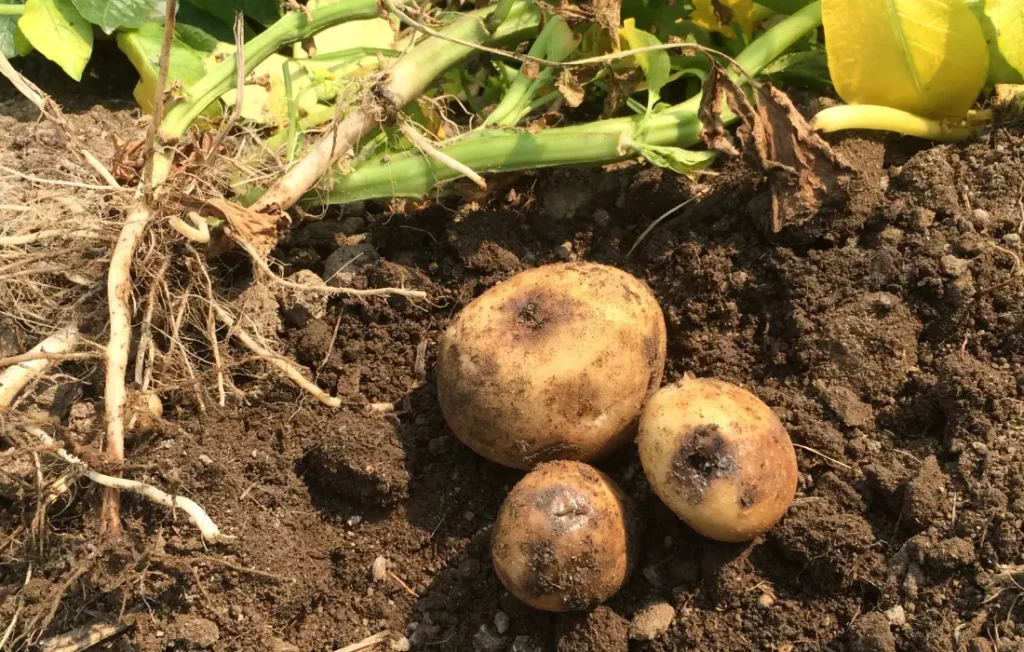
Potatoes are among the most closely monitored crops in the field because they react quickly to stress and contamination. When foliage develops spots, stems turn black, or tubers deteriorate, losses can extend far beyond yield, impacting storage quality, marketing, and production consistency. To effectively manage these problems, it’s essential to first recognize major diseases, identify their early signs, and link symptoms to field conditions. Discover how to identify these diseases and the appropriate natural solutions for effective control.
- Potato blight
- Alternaria
- Rhizoctonia solani
- Black leg / soft rot
- PVY (virus Y)
- PLRV (Potato leafroll virus)
- Nematodes
- Common scabies
- Silver scurf
- Dartrose (black dots / black dot)
- Fusarium solani
- Gangrene (Phoma)
- Powdery scabies
- Potatoe mop-top virus (PMTV)
- Tobacco rattle virus / Spraing
- Brown rot
- Ring rot
- Potato wart disease
- Potato smut
- 🥔 Agrobiotop solutions for controlling potato diseases
Potato blight
Potato blight , caused by Phytophthora infestans , remains the most feared disease of potatoes due to its potentially rapid progression. The first signs often appear on the leaves as small, discolored spots that quickly turn brown, surrounded by a light green to yellow halo. When humidity sets in, a white, powdery coating becomes visible, especially on the undersides of the leaves, along the edges of the lesions. The stems may also develop necrotic brown spots , and the entire foliage can be destroyed in a very short time. On tubers, symptoms appear as poorly defined external brown to purplish-gray mottling, followed by internal rust visible when cut under the skin. In cool, humid climates, with dense vegetation and temperatures around 15 to 20°C, the cycles occur in quick succession, which explains the rapid outbreaks and sometimes total losses.
Alternaria
Alternaria blight is primarily caused by Alternaria solani and Alternaria alternata , two fungi that readily infect already weakened plants. It is first detected on the lower leaves, where distinct necrotic spots appear , often marked with concentric rings as they enlarge. This “bull’s-eye” appearance greatly aids visual diagnosis. On tubers, the disease causes dry, brown to black rots with slight depressions . It is more prevalent in warm conditions, with alternating dry and humid periods, nighttime dew, and crop stress. It also thrives during senescence, nutritional imbalances, drought, or injury. Its economic impact is sometimes underestimated, even though it is present in most production areas and could become more widespread during warmer seasons.
Rhizoctonia solani
Rhizoctonia, caused by Rhizoctonia solani , usually affects the crop from the very beginning of its growth cycle. Early in the cycle, it causes irregular or late emergence , especially when the soil remains cold and damp after planting. Sprouts and runners then develop brown spots and necrosis, sometimes with a complete failure of emergence in severe cases. Later, the attack on the base of the stems leads to a characteristic growth habit, with curling, a purplish edge, yellowing, and drying out , sometimes accompanied by aerial tubers. A whitish sheath may form at the base of the stems in very humid conditions. The tubers themselves exhibit deformations, cracks, superficial damage, and, most notably, clearly visible black sclerotia at the end of the cycle. This disease negatively impacts crop establishment, batch uniformity, and the final appearance of the potatoes.
Do you need expertise and solutions for your potato crops?
Black leg / soft rot
Blackleg and soft rot are caused by several bacteria of the genera Pectobacterium and Dickeya . The problem sometimes begins even before emergence, when the mother tuber rots, leaving gaps in the field. On the vegetative stage, the base of the stem blackens and decomposes, with the symptoms appearing more pronounced in wet or dry conditions. In humid weather, a true black and wet rot is observed ; in warmer, drier weather, the plants wilt more. Yellowing, curling, internal necrosis, or hollow stems may also appear. On tubers, the flesh becomes soft, whitish to cream-colored, then darker at the periphery, with strong odors in cases of secondary infection. Humidity, waterlogged conditions, and temperatures favorable to bacterial growth play a major role in the expression of the disease, which affects both emergence and storage quality.
PVY (virus Y)
Potato virus Y (PVY) is one of the most variable viruses observed in the field, as its symptoms change depending on the strain, variety, and timing of infection. In primary infection, necrosis can be seen on the veins , especially on the undersides of leaves, as well as brittle leaves that dry out without actually falling off. Other forms produce more or less deforming mosaic patterns. In secondary infection, the symptoms are often more pronounced, with curling, puckering, mottling, or non-deforming mosaic. The disease is mainly spread via aphids and infected tubers , with an increased risk when volunteer plants, weeds, and neighboring crops act as reservoirs. Its economic impact can be very significant, with high yield losses in some contexts, and a major challenge for the seed potato industry where downgrading is a serious issue.
PLRV (Potato leafroll virus)
PLRV presents a rather different picture from PVY, with foliage that is often more rigid and upright. In primary infection, the upper part of the plant becomes lighter in color, with slight curling and sometimes purplish hues. In secondary infection, the symptoms become much more pronounced: smaller plants, lower leaflets strongly curled, brittle leaves, purplish margins, shortened internodes, and a very upright posture. Tubers can also be affected, with smaller offspring and sometimes internal necrosis in a network pattern. The virus is persistently transmitted by certain aphids, notably Myzus persicae , which alters the dynamics of infection. On susceptible varieties, yield losses can be very high, along with a decline in the internal quality of the tubers.
Nematodes
Potato nematodes are a group of several soil pests capable of severely damaging roots and tubers. Their harmfulness stems as much from the direct damage they cause as from their ability to persist in fields and complicate diagnosis.
- Species such as Meloidogyne chitwoodi and Meloidogyne fallax cause stunting in plants, galls on roots, and smooth deformities on tubers. Their presence is favored by low crop rotation diversity, and their identification often requires laboratory analysis.
- Primarily represented by Globodera pallida and Globodera rostochiensis , they cause patches of stunted vegetation, with weak plants and slowed growth. Highly persistent in the soil, they are easily spread via soil clinging to tools, wheels, shoes, or tubers.
Common scabies
Common scab is caused by several Streptomyces , soil bacteria that primarily affect the appearance of tubers. Symptoms are highly variable. Some lesions form raised bumps, pustules, or craters of varying depths; others remain more superficial, flat, corky, or reticular. Depending on the timing and severity of the infestation, stolons can also be affected, as can the root hairs on susceptible varieties. Infection occurs mainly during tuberization, often via the lenticels, and the soil is the primary source of inoculum. Light, well-aerated soils are more favorable. Even when yield is only slightly affected, the impact on the presentation of batches can be very detrimental, especially in the fresh market where visual quality is crucial.
Silver scurf
Silver scurf, caused by Helminthosporium solani , easily goes unnoticed in the field because it shows no symptoms on the foliage. The symptoms are most apparent on the tubers, where light, silvery patches appear, particularly noticeable on red-skinned varieties. As the disease progresses, fine black dots may appear, corresponding to the structures of the fungus. Its appearance is often more pronounced during storage than at harvest, especially if temperature and humidity conditions are favorable. The peeling of the skin then promotes dehydration and shriveling of the tubers. This disease primarily affects the appearance and weight loss of the tubers, with a frequent risk of confusion with black spot.
Dartrose (black dots / black dot)
Dartosis , caused by Colletotrichum coccodes , affects both foliage and tubers. On foliage, it can lead to premature dieback of the leaves, especially during hot summers, with drying from the top down, yellowing, and curling. The roots and the base of the stems can harbor small microsclerotia that ensure the fungus’s survival. On tubers, light gray to brownish-gray patches with diffuse edges are observed, sometimes visually similar to silver scab. The difference often lies in the size of the black spots, which are generally larger in dartosis. The main concern is commercial, as these skin defects lead to sorting and downgrading, even when the disease initially appears mild.
Do you need expertise and solutions for your potato crops?
Fusarium solani
Fusarium solani is caused by several species of Fusarium and primarily affects tubers, especially those stored in storage. The first signs are brown, slightly sunken areas on the skin. When cut, the rot progresses inward, appearing brown, with internal cavities sometimes lined with mycelium . If the rot persists, the tuber can dry out to the point of mummification. In more humid environments, opportunistic bacteria can colonize and transform this dry rot into soft rot. These fungi thrive on wounds from harvesting, sorting, handling, or transport, and then spread until the tissues have fully healed. Their impact is therefore significant on stock quality and the level of losses during sorting.
Gangrene (Phoma)
Gangrene, caused by Phoma exigua , often remains barely visible on the foliage, although premature yellowing may sometimes occur. Towards the end of the growing season, black pycnidia may be seen at the base of the stems. The disease becomes most evident on tubers, with sunken spots often located near a wound, eye, lenticel, or heel. When cut open, a dark brown dry rot is found, sometimes accompanied by small black structures in the cavities. The disease is favored by wounds and cool temperatures after harvest, which hinder healing. It primarily affects storage quality and the value of batches, especially when potatoes are intended for storage or seed potato production.
Powdery scabies
Powdery scab is caused by Spongospora subterranea , a highly persistent soil parasite. On tubers, it begins as pustules or galls that turn brown and eventually rupture, releasing a powder of spores. In advanced stages, the lesions leave small, empty depressions surrounded by a torn epidermis. On roots and stolons, galls or cankers may also appear. This disease is particularly favored by cool, wet conditions after emergence, making it especially prevalent in certain heavy or wet fields. Its economic impact stems from the degradation of tuber quality, but also from its role as a vector for PMTV, which adds a second layer of disease risk.
Potatoe mop-top virus (PMTV)
PMTV, or mop-top virus, is primarily problematic due to the damage it causes to tubers. Foliar symptoms are variable and sometimes absent, making the disease deceptive in the field. However, tuber necrosis can lead to batch rejections and severe downgrading, as the internal quality is no longer commercially acceptable. The virus is entirely dependent on Spongospora subterranea for its transmission, directly linking its risk to that of powdery scab. Cool, humid conditions therefore favor both the vector and the persistence of the problem. It is a disease with a significant impact on quality, sometimes only discovered late when tubers are cut or sorted.
Tobacco rattle virus / Spraing
TRV, or Tobacco Rattle Virus , primarily manifests as internal symptoms within the tubers. Upon cutting, pronounced necrotic arcs or irregular, sinuous lines appear, which can then expand into corky patches affecting a large portion of the tuber. On foliage, the signs are often less pronounced than on the harvested tuber. This disease depends on the presence of soilborne vectors, and its severity varies from one field to another depending on the interactions between the virus, the variety, and the environment. Its economic impact mainly affects market quality, as tubers that appear externally sound may be unsaleable once cut.
Brown rot
Caused by Ralstonia solanacearum , is a vascular bacterial disease with significant regulatory implications. The first symptoms on the plant may be subtle, with slight leaf curling and wilting that initially appears during the warmer months. This wilting may begin in one part of the plant before becoming widespread. On tubers, the vascular ring turns reddish-brown, then beige to brown , sometimes with a visible whitish exudate. In some cases, this exudate also appears near the buds or base of the stem and forms crusts with the soil. Because this bacterium circulates in the vascular system, it rapidly affects plant function. In France, its importance stems from both the health risk and the regulatory consequences that an outbreak can trigger.
Ring rot
Ring rot, caused by Clavibacter michiganensis subsp. sepedonicus , is another vascular bacterial disease that is closely monitored. Symptoms on the plant often appear late and can be mistaken for a simple end-of-cycle event, with progressive wilting of the lower leaves, curling, chlorosis, and then the disease spreading upwards. More severe forms result in stunted growth or a rosette-like growth habit. On tubers, the vascular ring turns yellowish then brown, with a creamy exudate . In advanced stages, cracks, dark spots under the skin, and even internal decay without a strong odor may be visible. The bacterium spreads primarily through infected tubers and mechanical contamination. Its regulated status, combined with zero tolerance, makes it a highly sensitive disease for the entire sector.
Potato wart disease
Wart disease, caused by Synchytrium endobioticum , produces very characteristic growths on underground plant parts. Tubers and stolons then develop abundant tumors , often compared to small cauliflowers. The parasite lives in the soil, without producing mycelium, and can persist there for a very long time as overwintering spores. Cool, moist conditions and well-draining soils are particularly favorable to it. Even though the disease is reported as eradicated in France, it remains a subject of monitoring due to its ability to establish itself permanently and the associated regulatory consequences. It is a rare but very serious threat.
Potato smut
Potato smut, caused by Thecaphora solani , is not a common disease in France, but it is important to be aware of it due to its quarantine status. Symptoms described in areas where it is present mainly affect the tubers, with deformities , warty galls, and spore-filled cavities when cut . The above-ground parts may show few signs of infection. In the French context, the main challenge lies in preventing its introduction through contaminated batches or potentially contaminated plant material. Even if absent from the country according to the sources cited, it falls into the category of pests that must be identified due to their regulatory implications.
🥔 Agrobiotop solutions for controlling potato diseases
We offer a program dedicated to potato cultivation in the form of a landscape representing the different phrenological stages, do not hesitate to contact us .
For this crop, late blight is clearly the leading potato disease, causing significant yield reductions and even total loss. AGROBIOTOP pays particular attention to other diseases such as Rhizoctonia solani, Fusarium wilt, and silver scab. Therefore, we have developed solutions that promote tuber coating to ensure high-quality and high-quantity potato harvests.
Regarding diseases, planting at emergence – Superficial tuber disorders
This includes silver scab, rots, Rhizoctonia solani, Fusarium wilt, and tuber blistering (a physiological disorder). Consult us for tuber coating solutions. We recommend:
For diseases occurring during the growing season
This particularly concerns nematodes. We advise you to:
For stem diseases
This includes, in particular, Rhizoctonia brown rot, Sclerotium rot, Dartrose, Blackleg ( Erwinia caratovora ), Downy mildew, and Slerotinia rot. We advise you to:
For diseases affecting the leaves – superficial or deep infections of the tubers
This includes, in particular, Rhizoctonia solani, downy mildew, Alternaria leaf spot, grey mold, blackleg, Verticillium wilt, leafroll, mosaic virus, curly leaf spot, and mottle rot. We advise you to:
Please feel free to contact us for more information on the protocol to apply against each of these diseases.
Photo : Shutterstock