The leafhopper responsible for flavescence dorée, Scaphoideus titanus , is one of the most closely monitored pests in viticulture, not only because of its feeding, but also because of its role as a vector of the phytoplasma responsible for flavescence dorée. Present in many French vineyards, it requires close monitoring from the earliest larval stages, as the spread of the disease can lead to yield losses, weakened vines, and the need to uproot infected plots. Agrobiotop helps winegrowers identify this pest, recognize the associated symptoms, and integrate natural solutions into an effective protection strategy.
- What is flavescence dorée?
- Geographical distribution of flavescence dorée
- American grapevine leafhopper: the main vector of the disease
- Life cycle of Scaphoideus titanus
- How is the phytoplasma transmitted by the leafhopper?
- A disease that can spread rapidly in the fields
- Factors that favor the development of flavescence dorée
- Damage caused by flavescence dorée on the vine
- Possible confusion with other vine diseases
- Regulatory framework for the fight against flavescence dorée
What is flavescence dorée?
Golden flavescence is a serious disease of grapevines , caused by the flavescence dorée phytoplasma. This pathogen develops in the phloem, specifically in the sieve tubes, disrupting the flow of sap and progressively weakening the vine. In professional viticulture, this disease requires close monitoring, as it combines a highly damaging pathogen with a specialized vector: the flavescence dorée leafhopper, Scaphoideus titanus .
- Causative agent : flavescence dorée phytoplasma.
- Nature of the agent : small cell wall-less bacteria, belonging to the class of Mollicutes.
- Development zone in the plant : phloem of the vine.
- Main vector : flavescence dorée leafhopper, Scaphoideus titanus .
- Plant concerned : grapevine, mainly plants of the genus Vitis .
- Status : quarantine disease, regulated and highly contagious in viticulture.
- Severity : crop losses, reduced grape quality, possible death of the vine, risk of uprooting of contaminated vines or plots.
Geographical distribution of flavescence dorée
Flavescence dorée is present in most major wine-growing areas of southern Europe, with reports in Spain, France, Italy, Portugal, Switzerland, Slovenia, and Serbia. In France, it has been observed in several wine regions, including Aquitaine, Burgundy, Corsica, Languedoc-Roussillon, Midi-Pyrénées, Poitou-Charentes, Rhône-Alpes, and the Provence-Alpes-Côte d’Azur (PACA) region. Its vector, Scaphoideus titanus , was accidentally introduced from North America and became established in the vineyards of southwestern France in the early 20th century before spreading to other French wine-growing areas, Corsica, Italy, Switzerland, and southern Europe.
American grapevine leafhopper: the main vector of the disease
The leafhopper that causes flavescence dorée, * Scaphoideus titanus* , belongs to the order Hemiptera and the family Cicadellidae. The adult measures approximately 6 to 7.5 mm, with an elongated body and a mottled brown and yellow coloration. The larvae go through five successive instars; they are wingless, pale yellow in the first instar, then more yellow in instars 2 and 3, with two characteristic black spots at the tip of the abdomen. In instars 4 and 5, the pigmentation progresses on the abdomen and then on the thorax. Both larvae and adults feed on sap, primarily by piercing the underside of leaf veins. Direct nutritional damage remains secondary; the major agronomic risk comes from the transmission of the flavescence dorée phytoplasma.
Do you need expertise and solutions against the American grapevine leafhopper Scaphoideus titanus ?
Life cycle of Scaphoideus titanus
The American grapevine leafhopper (Scaphoideus titanus) has only one generation per year and completes its entire life cycle on the grapevine. The insect overwinters as eggs laid in the bark of the vine. Hatching occurs in the spring and can extend from early May to early July, which explains the simultaneous presence of several larval stages in the same plot. The five larval stages succeed one another approximately every ten days under natural conditions, with a total development time of about 50 to 55 days, sometimes 6 to 8 weeks depending on the climate. The first adults often appear between early and mid-July, become sexually mature after about ten days, and egg-laying peaks in August and September before the adults die in the autumn.
How is the phytoplasma transmitted by the leafhopper?
Transmission begins when the leafhopper pierces an already diseased vine to feed on the phloem. This phase corresponds to the acquisition of the phytoplasma. After this infectious meal, the insect does not become infectious immediately: a latency period of approximately 30 days is required. During this phase, the phytoplasma crosses the intestinal wall, reaches the hemolymph, infects various organs, and multiplies, particularly in the salivary glands.
When the phytoplasma reaches the salivary secretory cells, the leafhopper can inject it into a new vine during another feeding. After this incubation period, the insect remains infectious for its entire life and can contaminate several vines as it moves. The phytoplasma is not transmitted to the leafhopper’s offspring. Once established in the vine’s phloem, it can multiply and persist in the vine for the vine’s entire life.
Transmission by grafting
Golden flavescence can also be transmitted through grafting when wood from infected mother vines is used in nurseries. Infected plants can then introduce the disease to new vineyards, sometimes far from the initial outbreak. For professionals in the wine industry, the health of mother vines and plant material is therefore a major point of vigilance in limiting the risk of spread.
A disease that can spread rapidly in the fields
Without control of the vector and infection sites, flavescence dorée can spread rapidly. Dissemination is facilitated by the leafhopper’s feeding activity on the vine, with progression often observed from one vineyard to the next. In vineyards, the disease frequently appears as patches, which enlarge year after year from a primary infection site. Abandoned vines, wild regrowth, and infected vines can maintain the phytoplasma in the vineyard environment and fuel new infections.
Factors that favor the development of flavescence dorée
The development of flavescence dorée depends on the interaction between the host plant, the vector, cultural practices and climatic conditions.
- Climate influences the cycle of Scaphoideus titanus , particularly the periods of hatching, larval development and the emergence of adults.
- Grafting practices can promote the spread of the disease when the plant material is contaminated.
- The grape variety cultivated influences susceptibility to disease and the speed of spread.
- The Cabernet Sauvignon, Sauvignon and Chardonnay grape varieties are particularly sensitive, with sometimes rapid progression in the plots.
- The Merlot, Sémillon and Syrah grape varieties are considered more tolerant, with generally slower dissemination.
- The presence of diseased vines, wild regrowth or abandoned vines increases the risk of phytoplasma persisting in the vineyard.
Damage caused by flavescence dorée on the vine
The leafhopper feeds on sap by piercing, but the losses observed in the vineyard are mainly linked to its ability to transmit the phytoplasma responsible for flavescence dorée.
The infected vine can suffer lasting weakening and then die, sometimes approximately two years after infection. Yield losses can be significant, particularly due to wilting of the inflorescences and drying of the grape bunches.
Symptoms may remain localized to a part of the vine or affect the entire plant. Their expression varies depending on the vigor of the vine, the grape variety, climatic conditions, and the stage of development. Symptoms are generally not visible in the year of infection; they usually appear the following year, sometimes several years later.
- In spring , the vine may exhibit delayed bud break and wilting of the inflorescences.
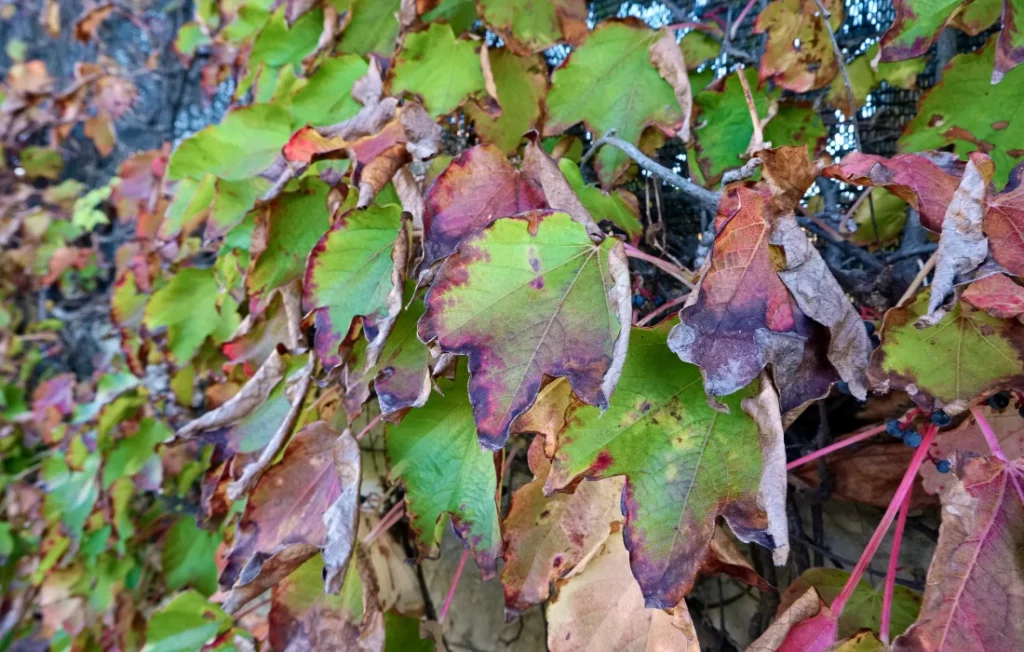
- At veraison , the leaves become hard, brittle, discolored and more or less curled depending on the grape variety.
- On white grape varieties, the leaves turn yellow; on red grape varieties, they turn red.
- The bunches can dry out from the stem.
- Berries from diseased vines can become fibrous, with a bitter and sour taste.
- The quality of the grapes is severely degraded, with a direct impact on the quality of the wine and its marketing.
- At the end of summer , the wood may not harden properly: the branches remain green, flexible and sometimes drooping.
- Brown spots may appear on the bark.
- Rootstocks often show few symptoms, but can still carry the phytoplasma.
- Wild vine regrowth can serve as a source of contamination.
- Heavily contaminated plots may be subject to uprooting measures.
Possible confusion with other vine diseases
The symptoms of flavescence dorée can be confused with those of excoriosis, particularly when vein and petiole discoloration or partial lignification is observed. Confusion also frequently occurs with bois noir, another phytoplasma disease that causes similar symptoms. In the field, visual observation guides the diagnosis, but reliable differentiation between bois noir and flavescence dorée requires laboratory analysis.
Regulatory framework for the fight against flavescence dorée
Flavescence dorée is a quarantine disease. In infected areas, control measures are regulated and mandatory due to the severity of the disease, its high rate of spread, its economic impact, and the risks it poses to neighboring vineyards. For winegrowers, this regulatory framework requires constant monitoring of reported outbreaks, symptomatic vines, and the presence of the vector within the plots.
Other tips on grapevines:
Photo: Shutterstock