The oriental fruit fly, or Bactrocera dorsalis , poses a major threat to fruit and vegetable production. Belonging to the Tephritidae family , this pest is known for its high invasiveness and its ability to cause significant economic losses in many crops. For professionals, its rapid identification and risk monitoring are crucial for protecting orchards, vegetable plots, and the commercial quality of harvests.
- Fact sheet for the oriental fruit fly
- Which crops are susceptible to Bactrocera dorsalis?
- How to identify the oriental fruit fly?
- Where is Bactrocera dorsalis found?
- What is the life cycle of Bactrocera dorsalis?
- What damage does the oriental fruit fly cause?
- What is the regulatory status of Bactrocera dorsalis?
- What preventative measures should be put in place in agriculture?
Fact sheet for the oriental fruit fly
The oriental fruit fly, scientifically known as Bactrocera dorsalis , is a fly belonging to the family Tephritidae . It is also called the Asian fruit fly or the oriental fruit tree fly. Native to Southeast Asia and parts of the Pacific, it attacks fruit in its larval stage. The larvae consume the pulp, promote rot, cause premature fruit drop, and render the fruit unfit for consumption or sale.
Which crops are susceptible to Bactrocera dorsalis?
Bactrocera dorsalis has a very wide host range , with over 400 plant species involved. It can lay its eggs in the fleshy fruits of many wild or cultivated species, which greatly complicates monitoring in production areas.
It affects tropical fruit trees, temperate fruit trees, and certain vegetable crops:
- citrus fruits;
- avocado;
- banana tree;
- mango tree;
- papaya;
- plum tree;
- guava;
- tomato ;
- peppers;
- cherry tree;
- pineapple ;
- fishing;
- pear tree;
- apricot tree;
- fig tree.
This diversity of hosts increases the risk of the pest remaining in the environment, especially when several susceptible crops follow one another or coexist in close proximity.
Do you need solutions to combat the oriental fruit fly?
How to identify the oriental fruit fly?
Identifying Bactrocera dorsalis requires careful observation, as the species can be confused with several other flies of the genus Bactrocera .
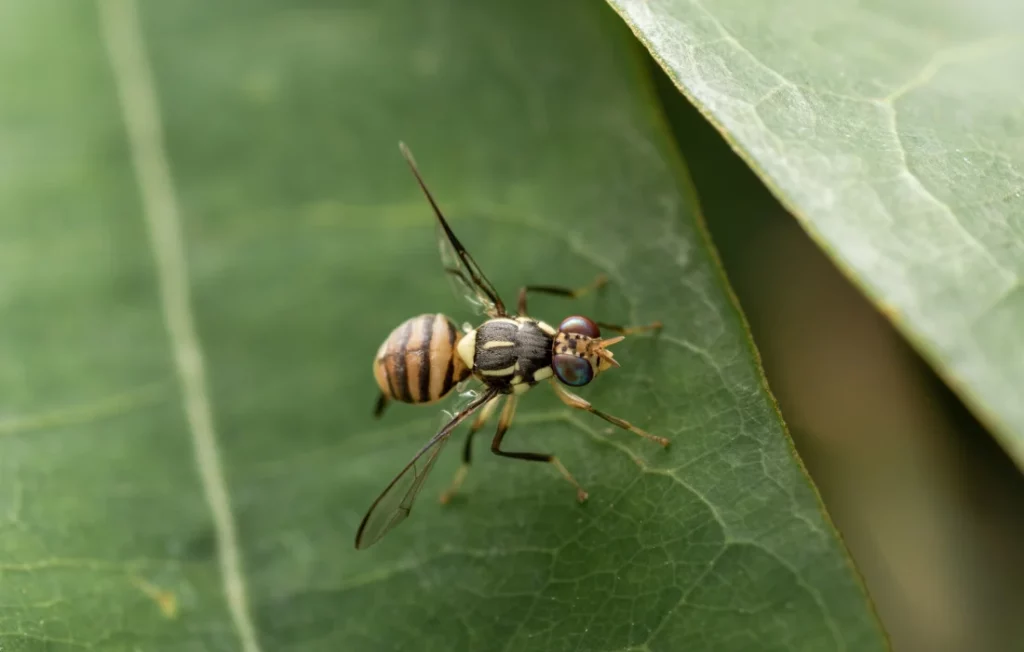
- Adult : It measures 4 to 8 mm in length, with a dark thorax on its back and orange-brown hues. The abdomen varies from pale to dark and has a dark longitudinal band, forming a T-shaped pattern with a transverse band at the base of the third abdominal segment. The wings measure approximately 7.3 mm. The female has a prominent ovipositor, used to deposit eggs under the skin of fruits.
- Eggs : They are white, elliptical, approximately 1.17 mm long and 0.21 mm wide. They generally hatch after 1 to 3 days when conditions are favorable.
- Larvae : They are creamy white and can reach about 10 mm in length. They are the ones that cause direct damage, as they develop in the pulp of the fruit.
Where is Bactrocera dorsalis found?
Bactrocera dorsalis is native to Asia , but its range has expanded considerably. It is now present in much of Africa, from the Indian subcontinent to China, throughout Southeast Asia, and on several islands in the Pacific and Oceania. In the southwestern Indian Ocean, it is reported or closely monitored in Mayotte, Réunion, Madagascar, Mauritius, and the Comoros. Its arrival in Réunion was reported in 2017. Outbreaks were also reported in Italy in 2018, despite European regulations aimed at limiting its introduction. International trade in fresh fruits and vegetables contributes to its spread.
In mainland France , the oriental fruit fly is not considered established. No established outbreaks have been confirmed through enhanced surveillance. However, sporadic captures have been recorded since 2019, particularly in Occitanie, Île-de-France, Provence-Alpes-Côte d’Azur, Grand Est, and Auvergne-Rhône-Alpes. These detections are mainly associated with imports of exotic fruits, which places market, transit, and consumption areas under surveillance.
What is the life cycle of Bactrocera dorsalis?
Bactrocera dorsalis is adapted to hot, humid tropical climates . In favorable areas, its life cycle can continue year-round. Adults become dormant below 7°C and die below 2°C, which limits its long-term establishment in colder regions. In summer, complete development from egg to adult can take approximately 16 days. The female lays her eggs under the skin of the fruit. The larvae, also called maggots, develop in the pulp and feed on the flesh. After developing, they leave the fruit, burrow into the soil, and then pupate. The adults then emerge from the soil. A female can lay up to 3,000 eggs under optimal conditions, with an average laying rate of between 1,200 and 1,500 eggs per female. This high fecundity explains the rapid spread of infestations when temperatures, humidity, and fruit availability are favorable.
What damage does the oriental fruit fly cause?
The damage is mainly caused by larvae, which develop inside fruits and vegetables by consuming the pulp.
This activity entails:
- a deterioration of the flesh;
- fruit rotting;
- the presence of wormy fruit;
- premature fruit drop;
- a loss of sanitary quality;
- a loss of commercial value;
- lots unsuitable for sale;
- losses can amount to the total destruction of the fruit.
In susceptible orchards and crops, the consequences can be severe. Affected fruit quickly loses its market value, even when the infestation remains localized. For the supply chain, the risk concerns not only yield, but also sorting, sanitary compliance, market access, and the management of suspect batches.
What is the regulatory status of Bactrocera dorsalis?
Bactrocera dorsalis is classified as a Priority Quarantine Organism at the European level under EU Regulation 2016/2031. This status applies to pests of potential economic importance to the European Union that are absent or present only in limited numbers, not widely disseminated, and subject to official control measures. This classification entails obligations for detection, monitoring, eradication, and follow-up in the event of an outbreak. In France, the species is subject to a national emergency health intervention plan, which defines the procedures to be applied upon detection of an outbreak.
What preventative measures should be put in place in agriculture?
Prevention aims to limit the sources of infestation, the fruits attractive for egg-laying, and the stages of the pest present in the plot.
- Regularly collect fallen fruit from the ground , as it may contain developing larvae.
- Destroy infested or suspected fruit to limit the continuation of the biological cycle.
- Avoid harvesting overripe fruit , which makes the fruit more attractive to females.
- Reduce the prolonged presence of fleshy fruits on the plot , especially in at-risk areas.
- Tilling the soil when it is suitable for the crop , in order to disturb the pupae present in the first few centimeters.
- Install insect-proof nets on sensitive crops , where cultivation practices allow.
- Strengthen surveillance of plots near import areas, markets or transit points , as incursions are often linked to imported exotic fruits.
- Check for suspicious fruit during harvesting and sorting , especially in case of punctures, softening or the beginning of rot.
Other pests:
Photo : Shutterstock