
What pests can cause carrots to be riddled with holes, misshapen, stunted, or difficult to harvest? Agrobiotop helps you identify the damage caused by each pest and adopt the right solutions to protect your carrot crops.
Carrot fly
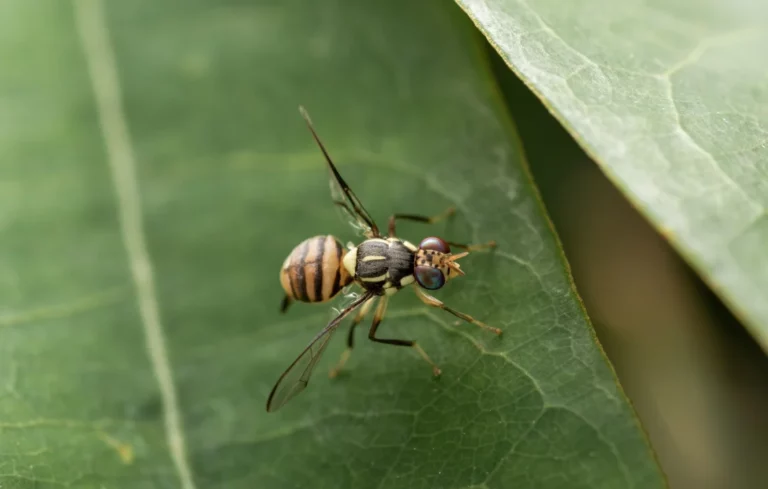
The carrot fly (Chamaepsila rosae , also called Psila rosae) is one of the most well-known carrot pests. The adult, a small, blackish fly 4 to 5 mm long with yellow legs, does not directly cause damage: it is the yellowish-white larvae that mine the rootlets and then the taproot. Affected carrots may show yellowing, reddening, or wilted foliage, with stunted growth. On the root, entry holes and, more importantly, brownish, winding galleries are visible, sometimes followed by secondary rot that severely degrades the harvest.
Wireworms
Wireworms (Agriotes spp.) are the subterranean larvae of beetles in the family Elateridae. These yellow to yellowish-brown, cylindrical, and very hard larvae live for a long time in the soil and attack the underground parts of many crops. On carrots, they bore through the taproot, leaving clean, dry, sometimes deep perforations distributed throughout the root. Unlike carrot fly damage, the holes are more pronounced, less sinuous, and the foliage often remains only slightly affected.
Cutworms
Cutworms (Agrotis spp. , particularly Agrotis segetum and Agrotis ipsilon), are thick, grey-brown, nocturnal caterpillars that curl into a C-shape when disturbed. They primarily attack young plants, which they can sever at the base, causing gaps in the rows. They can also bite leaves, the base of the plant, the shoulders, or the roots. Damage is often sporadic, but very noticeable when several seedlings suddenly disappear near the ground.
Seedling flies
Seedcorn maggot (Delia platura) and bean seed maggot (Delia florilega) are small gray flies whose white larvae attack germinating seeds, the hypocotyl, and young roots. On carrots, their presence is most noticeable by irregular or insufficient emergence. Seeds may be destroyed, blackened, or produce weak seedlings that yellow and then wilt. The most telling sign is therefore poor emergence, often even before the gardener sees a true pest on the surface.
Do you need expertise and solutions for your carrot crops?
Carrot mining fly
The carrot mining fly (Napomyza carotae) is a fly whose larvae mine the leaves, petioles, and sometimes the surface of the crown or root. Damage appears as light-colored mines on the foliage, petiole galleries, and superficial alterations on the upper part of the taproot. It weakens the plant, but its damage is generally more superficial than that of the carrot fly, which bores deeper into the root.
Garden symphyrin
The common symphylan (Scutigerella immaculata) is not an insect, but a small, shiny, white, highly mobile soil arthropod measuring approximately 5 to 7 mm. It has long antennae and twelve pairs of legs. On carrots, both juveniles and adults attack germinating seeds, root hairs, and young roots. Damage results in poor germination, collapsed seedlings, scattered patches of infestation, and small cavities on the roots.
Spotted snake millipede
The spotted millipede (Blaniulus guttulatus ) is a very elongated, pale cream-colored millipede, recognizable by the small reddish-brown spots on its sides. It is primarily saprophagous, but may also feed on tender, cracked, or already damaged roots. On carrots, its damage is often secondary: superficial nibbling, scarring, and the worsening of existing cracks and rot. It frequently curls up when at rest, which helps to identify it when observing the soil or damaged roots.
Carrot psyllid
The carrot psyllid (Trioza apicalis) is a small, pale green, jumping, piercing-sucking insect with black antennae and red eyes. Both adults and nymphs attack the foliage, especially on young carrots. Damage can be rapid and severe: curled leaves, yellowing, purplish discoloration, stunted growth, shortened taproot, and abundant development of secondary rootlets. This pest is particularly prevalent in Nordic countries and parts of Central Europe.
Mediterranean carrot psyllid
The Mediterranean carrot psyllid (Bactericera trigonica) is a psyllid belonging to the Apiaceae family and found in several regions of the Mediterranean basin. It lives primarily on the undersides of leaves, where the flattened nymphs may be surrounded by shiny, waxy filaments. Damage involves feeding, weakening, and sometimes the transmission of pathogens: small lesions, discoloration, chlorosis, honeydew, loss of vigor, and, in severe cases, yellow-bronze-purple foliage, stunted roots, and an abnormal number of rootlets.
Aphids
Carrots can host several species of aphids, with colonies visible on the foliage, sometimes hidden at the base or established on the roots, and damage ranging from simple leaf curling to marked stunting of the plant.
- Aphid Cavariella aegopodii : pale green aphid found mainly on young leaves, responsible for discoloration, curling, early drying and sometimes honeydew; it is also known as a vector of viruses.
- Aphid Semiaphis dauci : aphid often visible on the upper surface of leaves, leaflets or umbels, causing very puckered, curled, rolled foliage and slowed growth of young shoots.
- Aphid Dysaphis crataegi : a more hidden species, located at the base of petioles, at the collar or near shallow roots, with grey-green colonies sometimes accompanied by ants and localized damage of stunting and deformation.
- Aphid Pemphigus phenax : subterranean aphid forming white woolly colonies on roots, often with ants, and causing general weakening and slowed growth.
- Aphid Myzus persicae : polyphagous aphid present on the foliage, capable of causing curling, stunting and loss of vigor in the case of large colonies, but especially feared for its possible role in the transmission of viruses.
Aster leafhopper
The aster leafhopper (Macrosteles quadrilineatus) is a small, spindle-shaped, yellowish-green, piercing-sucking insect that is very mobile and capable of jumping quickly. It feeds in the phloem and is particularly harmful as a vector of aster yellows. On carrots, symptoms can include small whitish spots, yellowing, curled leaves, leaf proliferation in the heart of the plant, and thin, very hairy, sometimes bitter roots. This pest is mainly reported in North America.
Two-spotted spider mite
The two-spotted spider mite (Tetranychus urticae) is a tiny, yellowish to greenish mite, marked by two dark spots on its back. It lives primarily on the undersides of leaves and thrives in hot, dry weather. On carrots, it causes a yellowish, speckled appearance, followed by browning, leaf drying, and sometimes the formation of fine webbing. Damage is often minor on carrots grown for consumption, but can become more problematic in certain situations, particularly in seed crops or during periods of water stress.
Carrot weevil
The carrot weevil (Listronotus oregonensis) is a small brown beetle with a distinctive proboscis. Adults cut into the petioles and crown to lay their eggs, and then the white, arched, legless larvae bore into the collar and the top of the root. Damage is therefore often concentrated on the shoulder of the carrot: egg-laying marks, galleries, deformities, forks, and loss of market value. This pest is particularly problematic in Canada, especially in Quebec, and in the northeastern United States.lématique au Canada, notamment au Québec, et dans le nord-est des États-Unis.
Other tips:
Photo : Shutterstock