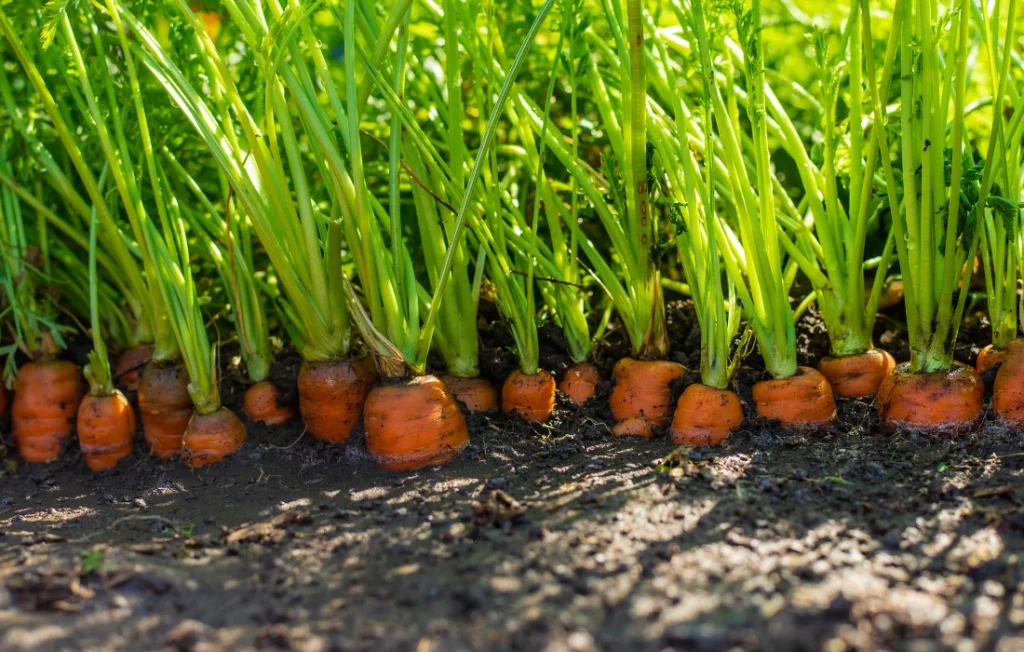
Do your carrots have spots on their leaves, cracked, blackened, or rotten roots? Carrot diseases are numerous and can affect the crop from emergence, weakening the leaves, slowing growth, and significantly degrading root quality before harvest or during storage. Agrobiotop helps you identify the various problems and provides natural solutions, drawing on its expertise in agrobiology.
- Alternaria leaf spot of carrots
- Alternarian black rot of the collar
- Cercospora leaf spot of carrots
- Carrot mildew
- Bacterial burn of carrots
- Damping-off of carrot seedlings
- Cavity spot
- Pythian root dieback
- Brown carrot rhizoctonia
- Cubic rot
- Purple Rhizoctonia
- Sclerotinia
- Carrot burn
- Grey rot
- Mycocentrospora-related rot
- Black spot caused by Rhexocercosporidium
- Black root rot
- Fusarium wilt of the roots
- Common carrot scab
- Soft bacterial rot
- Brown rot caused by Plenodomus
- Itersonilia chancre
- Aster yellows
- Stubborn
- Zebra Chip Disease
- Variegated carrot dwarfism
- Carrot yellow leaf virus (CYLV)
- Parsnip yellow fleck on carrot
- Carrot thin leaf disease
- Carrot virus Y
- Carrot root-knot nematodes
- Major abiotic and physiological disorders
Alternaria leaf spot of carrots
Alternaria blight is caused by the fungus Alternaria dauci . It is present in most carrot-growing areas, especially in temperate and subtropical regions. It develops with prolonged leaf wetness, rainfall, irrigation, and temperatures close to 28°C. In the field, it is recognized by dark brown to black spots, often bordered by a yellow halo, initially visible on older leaves, followed by progressive leaf scorch. The petioles can also be affected, which weakens the foliage and complicates mechanical harvesting.
Alternarian black rot of the collar
Alternaria black rot of the crown is primarily associated with Alternaria radicina , with more recent reports of Alternaria carotiincultae and, in some complexes, Alternaria alternata . It is favored by warm, humid weather, spraying, wounds, contaminated residues, and infected seeds. Symptoms often begin at the base of the petioles or the crown: the root shoulder turns black, then a dark, dry rot may spread down the taproot and persist during storage.
Cercospora leaf spot of carrots
Cercospora leaf spot is caused by the fungus Cercospora carotae . It is widespread throughout the world. Periods of rain, irrigation, and persistent moisture on the leaves create favorable conditions, with an optimum temperature close to 28°C. The leaves develop small, beige to light brown, mostly circular lesions surrounded by a chlorotic halo. The leaflets yellow and sometimes curl, while the petioles and stems may show dark brown, elliptical lesions.
Carrot mildew
Carrot powdery mildew is caused by fungi of the genus Erysiphe , primarily Erysiphe heraclei . It is reported in many production areas, especially in late summer or autumn, in dry to temperate climates. Warm weather, moderate relative humidity, and dense foliage are sufficient for its development. It forms a powdery white coating on the leaves and petioles, followed by slight yellowing and progressive drying of the foliage.
Do you need expertise and solutions for your carrot crops
?
Bacterial burn of carrots
Bacterial blight is caused by Xanthomonas hortorum pv. carotae . It is present in most carrot-growing areas and is particularly detrimental to seed production. The bacterium spreads mainly through seeds, carrot debris, rain, and sprinkler irrigation, with favorable temperatures around 25 to 30 °C. The leaves show small, irregular yellowish spots, which then turn watery brown, often surrounded by a yellow halo. Brown streaks may appear on the petioles and stems, sometimes accompanied by an amber bacterial exudate.
Damping-off of carrot seedlings
Damping-off is a syndrome caused by several soil pathogens, including Globisporangium ultimum , various Pythium spp. , Rhizoctonia solani , and certain Fusarium spp. Cold, wet, poorly structured soils, overly dense sowing, and poorly draining plots promote infection. Symptoms appear very early: poor emergence, lodging seedlings, watery necrosis at the collar, and rot of the young taproot or rootlets.
Cavity spot
Pythium cavity, or cavity spot, is caused by several oomycetes, including Pythium violae , Pythium sulcatum , and other Pythium species or Globisporangium spp . It is common in intensive production systems in temperate climates. Cold, wet soils, low-lying areas, over-irrigation, and poor drainage increase the risk. The disease produces small, sunken, elliptical, or irregular lesions on the roots, often located on the upper third of the taproot. These darken over time and can be colonized by other fungi, sometimes making diagnosis difficult at harvest.
Pythian root dieback
Pythium root rot is caused by soilborne oomycetes, notably *Pythium irregulare *, *Pythium ultimum* , and other *Pythium* spp. Young taproot tissue is most susceptible, especially in very wet, poorly drained soil or with a high inoculum level. Symptoms include forked, truncated, rough, or rusty roots, with dead lateral roots. Foliage may remain indistinct, making observation of young roots crucial for diagnosis.
Brown carrot rhizoctonia
Brown rhizoctonia is caused by Rhizoctonia solani , primarily groups AG-2-2 and AG-4 , depending on the region. This disease is worldwide, but its intensity often varies from field to field. Warm, moist soils, water or nutrient stress, injuries, and degraded soil structure favor its development. On carrots, it can cause early damping-off, cankers, irregular, sunken black lesions at the crown or on the lenticels, followed by root rots that can progress during storage.
Cubic rot
Crater-like rot is caused by Fibularhizoctonia carotae , formerly known as Rhizoctonia carotae . Cool, wet seasons, followed by prolonged storage in cold, humid conditions, promote its development. Roots may show brown bands or cankers at the collar and shoulder, followed by small, brownish, depressed craters. During storage, a white, flaky mycelium may develop on the lesions.
Purple Rhizoctonia
Purple rhizoctonia is caused by Helicobasidium purpureum , also known as Rhizoctonia crocorum . This disease occurs mainly in temperate regions, often in a localized but sometimes severe form. It is favored by heavy, acidic, moist, and poorly limed soils, with optimal infection around 15 to 16°C. Affected plants yellow, wilt, or remain stunted. A reddish-purple to pinkish-brown felt-like growth appears on the roots and underground parts, accompanied by dry rot that can progress to secondary, more moist rot.
Do you need expertise and solutions for your carrot crops
?
Sclerotinia
This disease is primarily caused by Sclerotinia sclerotiorum , and less frequently by Sclerotinia minor . It is found worldwide and is considered a major root and storage disease. Cool, humid conditions, dense canopy cover, moist soil, and poor aeration favor its development, often at temperatures between 13 and 21°C. The roots develop soft, water-soaked lesions that quickly become covered with a white, cottony mycelium. Black, irregular, and clearly visible sclerotia then form in or on the affected tissues.
Carrot burn
The blight is caused by Athelia rolfsii , formerly known as Sclerotium rolfsii . High temperatures, often exceeding 29°C, moist soils, and dense stands are favorable conditions. The foliage yellows and then quickly wilts, while the taproot develops a soft, watery rot near the soil line. The most telling sign is the presence of abundant white mycelium and small, light brown, spherical sclerotia, resembling mustard seeds.
Grey rot
Gray mold is caused by Botrytis cinerea , an opportunistic fungus widespread throughout the world. It primarily affects damaged, senescent, or weakened tissues, particularly during storage or harvesting. High humidity, condensation, harvest injuries, and cold damp conditions promote its spread. On stored roots, it causes soft, superficial or sunken lesions covered with a spore-forming, ashy-gray mold. Black sclerotia may also appear, which can lead to confusion with other storage rots.
Mycocentrospora-related rot
This rot is caused by Mycocentrospora acerina . Cool, humid climates, injured roots, pre-existing lesions, and prolonged storage promote its development. The roots initially show watery lesions, which then become black, sunken, and deep, often at the crown or tip. After several months of storage, these lesions can spread and severely degrade the commercial quality.
Black spot caused by Rhexocercosporidium
Black spot caused by Rhexocercosporidium carotae , formerly Acrothecium carotae , is a slow-progressing cold storage disease. It develops primarily during prolonged, cold, and humid storage. Symptoms appear as numerous small, slightly sunken, dark brown to black spots randomly distributed on the root. The lesions often remain shallow but are easily confused with other black storage spots.
Black root rot
Black root rot is caused by Berkeleyomyces basicola . Injuries, delayed cooling, high humidity, and inadequate storage conditions promote its development. The roots develop black, irregular, superficial lesions, often limited to the epidermis, while the flesh sometimes remains healthy. The presence of masses of brownish-black chlamydospores is a strong indicator of the origin of these spots.
Fusarium wilt of the roots
Fusarium wilt, also known as dry root rot, is a fungal disease affecting several members of the genus Fusarium , including Fusarium avenaceum, Fusarium tricinctum, Fusarium oxysporum , species of the Fusarium solani complex, Fusarium nirenbergiae, Fusarium triseptatum, and Fusarium acuminatum . Injuries, wet and compacted soils, high humidity, and prolonged storage promote the disease. Roots exhibit dry, pale brown to dark brown, circular or irregular lesions, often sunken, sometimes with pinkish or reddish mycelium in humid conditions.
Common carrot scab
Common carrot scab is caused by filamentous bacteria of the Streptomyces scabiei complex . Water stress during root initiation, certain poorly decomposed organic residues, and soils favorable to actinomycetes can exacerbate symptoms. The disease produces dry, corky, superficial or sunken lesions, sometimes pitted. It primarily affects the commercial appearance of the roots, without generally causing destructive rot during storage.
Soft bacterial rot
Bacterial soft rot is caused by bacteria such as Pectobacterium carotovorum subsp. carotovorum, Dickeya spp., or others. It is a worldwide disease that affects both field crops and harvested, washed, or stored batches. Injuries, standing water, handling shocks, frost, field heat, and high humidity promote its development. Roots become soft, watery, slimy, and often foul-smelling. The foliage may yellow and then collapse when the root base is destroyed.
Brown rot caused by Plenodomus
Brown rot is caused by Plenodomus libanotidis , formerly known as Leptosphaeria libanotis or Phoma rostrupii. The fungus can be seed-borne, survive on infected debris, and produce spores that are disseminated by splashing or cultural practices. Cool, humid conditions, around 14 to 18 °C, are favorable. On foliage, light brown lesions with small, dark pycnidia are observed. On roots, the disease can cause brown rot and wilting.
Itersonilia chancre
Itersonilia perplexans canker primarily affects umbellifers, with observations also being made on carrots, parsnips, parsley, and coriander. Cool, damp conditions favor spore dispersal and tissue infection. Leaves may show small orange to brown lesions surrounded by a pale green halo, while roots exhibit brown, black, or purplish-black cankers, especially at the crown and shoulder. Secondary decay can then alter the initial appearance.
Aster yellows
Aster yellows is caused by the fungus *Phytoplasma asteris* . This disease is widespread in temperate zones and can be significant in North America and Europe. It is highly dependent on the presence of leafhopper vectors, reservoir weeds, and conditions favorable to insect migration. Young leaves turn yellow, reduced, distorted, and crowded, while older leaves may turn purple or reddish. The roots remain small, deformed, and often have abundant root hairs.
Stubborn
It is caused by Spiroplasma citri , a mollicute bacterium of the phloem transmitted by leafhoppers. Warm seasons, the presence of vectors, and reservoir plants favor its spread. The leaves and petioles turn yellow-violet to dark purple. The taproot remains stunted, with numerous long, fibrous secondary roots, which can resemble other phloem diseases such as phytoplasma.
Zebra Chip Disease
Liberibacter yellows is associated with Candidatus Liberibacter solanacearum . It is primarily known in Northern and Central Europe, the United Kingdom, and on Apiaceae, with transmission via carrot psyllids. Vector pressure, plant reservoirs, and certain northern climates favor outbreaks. Leaves curl, yellow, bronze, or purplish hues, with a bushy growth habit and marked dwarfism. Roots become small, dehydrated, deformed, and often develop abundant secondary root hairs.
Variegated carrot dwarfism
Carrot mottle dwarf is a viral complex involving, among others, Carrot red leaf virus, Carrot mottle virus, Carrot mottle mimic virus , and other associated RNA viruses, depending on the outbreak. It is present in several areas where umbellifers and the aphid vector Cavariella aegopodii persist, particularly in Europe, Oceania, and North America. Mild winters, volunteer carrots, wild carrots, and aphid activity favor the disease. Affected plants exhibit reddening, yellowing, mottling, and stunted growth. Early infections result in small, stunted, and severely degraded roots.
Carrot yellow leaf virus (CYLV)
Carrot yellow leaf virus is a viral disease. The foliage may show nonspecific symptoms, such as yellowing of older leaves or mottling. The main defect is visible when cut: internal brown-black spots appear around the heart or crown, sometimes with few external signs.
Parsnip yellow fleck on carrot
Parsnip yellow fleck virus disease in carrots is a viral disease transmitted by aphids, with transmission mechanisms varying depending on the strain. High aphid activity and the proximity of umbelliferous plants (reservoirs) promote infection. Symptoms include yellowing, reddening, wilting, and sometimes complete dieback of the foliage. On the roots, reduced growth or slight browning of the crown may be observed in some areas, especially when infection occurs early.
Carrot thin leaf disease
Carrot thin leaf disease is caused by carrot thin leaf virus , a potyvirus transmitted by aphids in a non-persistent manner. Outbreaks occur in the presence of active aphids and carrot regrowth acting as a host. The foliage becomes thin, sometimes threadlike, and distorted, with a mild to moderate mosaic pattern. Root losses may remain limited in cases of isolated infection, but co-infections often exacerbate deformities and reduce fruit quality.
Carrot virus Y
Carrot virus Y is caused by Carrot virus Y , a potyvirus transmitted by aphids in a non-persistent manner. It is most common in Australia, where it can cause losses in young crops. The disease is favored by the proximity of inoculum sources and vector activity. Leaves show chlorotic mosaic, general chlorosis, redness, and sometimes marginal necrosis. They may also become more finely divided, giving a feathery appearance. When infection occurs early, the roots become stunted, bumpy, and deformed.
Carrot root-knot nematodes
Carrot root-knot nematodes belong to the genus Meloidogyne , with species such as Meloidogyne hapla, M. chitwoodi, M. fallax, M. incognita, M. javanica, and M. arenaria . They are found worldwide. Light to medium soils, sensitive crop rotations, and temperatures suitable for the species promote their development. The roots develop irregular galls, fork, become deformed, and produce excessive root hairs. The foliage may yellow, wilt, or remain stunted when the root system becomes inefficient.
Major abiotic and physiological disorders
Some carrot problems are not caused by an infectious agent, but by factors such as dense or stony soil, hardpan, excessive or irregular watering, shoulder exposure to light, deficiencies like boron, cold, frost, shock, or over-ripening. These disorders are universal and closely linked to the growing system. They cause forking, excessive root hairs, split roots, green shoulders, sponginess, internal browning, or storage injuries. Their difficulty lies in the fact that they can mimic diseases such as Pythian dieback, nematodes, or certain opportunistic rots.
Other tips:
Photo : Shutterstock