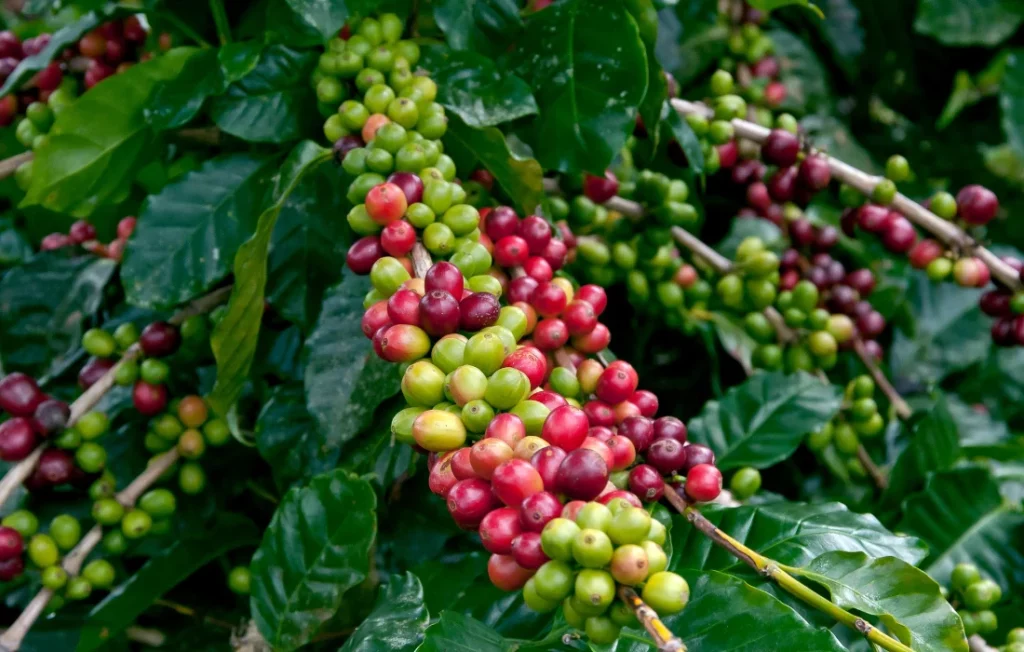
Orange rust on the leaves, brown spots, withering branches, falling berries: how can you recognize coffee tree diseases before they impact production? In nurseries and plantations alike, coffee trees can be affected by several pathogens capable of weakening the foliage, reducing photosynthesis, disrupting flowering, or altering the quality of the cherries. Given these sometimes similar symptoms, field observation remains the first step in making a reliable diagnosis. Agrobiotop helps you identify the various problems and provides natural solutions, drawing on its expertise in agrobiology.
Coffee leaf rust
Coffee leaf rust is caused by the fungus Hemileia vastatrix . Present in all major coffee-growing regions of the world, it is one of the most feared diseases in coffee cultivation. It develops primarily when humidity remains high, with prolonged wetting of the foliage, temperatures close to 21–25°C, a dense canopy, or weak coffee trees. In the field, it is recognized by irregular yellowish spots on the upper surface of the leaves, followed by powdery, yellow-orange pustules on the underside of the leaf blade. The lesions can merge, turn brown in the center, cause premature defoliation, and leave bare shoots.
Coffee berry disease
Coffee berry disease is caused by the fungus Colletotrichum kahawae . It primarily affects Arabica coffee grown at high altitudes, mainly in several African countries such as Kenya, Ethiopia, Uganda, Tanzania, Rwanda, Burundi, Malawi, Zambia, Zimbabwe, Mozambique, Angola, and Cameroon. Heavy rainfall, free water on the fruit’s organs, very high relative humidity, and temperatures around 22°C favor its development, especially on expanding berries a few weeks after flowering. Young fruits initially show small, water-soaked lesions, then slightly sunken, dark brown spots, sometimes accompanied by pale pink sporulation in humid weather. The berries may drop, turn black, mummify, or develop corky lesions.
Do you need expertise and solutions for your coffee crops ?
Cercospora leaf spot
Coffee leaf spot (Cercospora leaf spot) is caused by the fungus Cercospora coffeicola . Widespread in coffee-growing regions worldwide, it is often more pronounced in warm, humid environments at low altitudes, on Coffea canephora , or on weakened plants. Nutritional stress, inadequate shade, and the presence of infected leaves on the ground can promote its development. Symptoms begin as small chlorotic spots, which progress to reddish-brown lesions with gray centers, often surrounded by a yellow halo. On fruit, the disease can also cause “berry blotch” or “berry spot” lesions, with a more visible impact on young plants, nurseries, and already stressed coffee trees.
American leaf spot of coffee
Coffee leaf spot, also known as American coffee disease, is caused by the fungus Mycena citricolor . It is found primarily in Central America and other humid Neotropical regions, with documented occurrences in Mexico, Costa Rica, Guatemala, and throughout Latin America. It particularly affects high-altitude Arabica coffee plants when relative humidity is high, temperatures remain cool (around 20-23°C), and the plot exhibits excessive shade, high planting density, low sunlight, or inadequate drainage. The leaves develop brown lesions with reddish margins, often arranged in concentric rings. In advanced stages, the necrotic tissue may perforate. Elongated lesions also appear on stems and branches, while the fruit may show sunken areas.
Phoma leaf spot of coffee
Coffee leaf spot, or phomosis, is caused by the fungus Boeremia exigua pv. coffeae . Available sources report its presence primarily in high-altitude areas of Brazil, with a wider geographical distribution that is less well documented. It readily appears in conditions of cold winds, repeated rainfall, and high altitude, sometimes coexisting with halo blight. The disease is observed on young leaves, where it causes lesions and progressive drying. It can also affect young shoots, flowers, and very young berries, making diagnosis sensitive to the time of observation and the stage of development of the coffee plant.
Tracheomycosis of coffee
Coffee wilt, also known as tracheomycosis, is caused by the fungus Fusarium xylarioides . This serious vascular disease is primarily associated with sub-Saharan Africa, with reports in the Democratic Republic of Congo, Uganda, Tanzania, Ethiopia, and several countries in Central and West Africa. It is favored by the presence of inoculum in the soil, wounds to the collar or roots, the movement of infected plants, and practices that weaken the base of the trees. Affected coffee trees turn yellow, lose their leaves, dry out, and may sometimes die on one side only. The cherries die, the bark cracks, the trunk may swell, and a blue-black discoloration under the bark is a strong indicator in the field.
Bacterial halo blight of coffee
Halo blight of coffee is caused by the bacterium Pseudomonas syringae pv. garcae . It has been reported in Brazil, Kenya, Ethiopia, India, and China, among other countries. Cool conditions, rain, strong winds, altitude, and injuries from pruning or abrasion promote its development, with young plants and nurseries being particularly susceptible. The leaves show brown lesions surrounded by a yellow halo, a fairly clear symptom when the disease is well established. It can also lead to severe defoliation, affect flowers and small berries, and then cause dieback of shoot tips and some branches.
Coffee leaf scorch
Bacterial leaf blight of coffee, also known as coffee leaf scorch , is caused by Xylella fastidiosa subsp. pauca . It is primarily documented in Brazil, with reports from Costa Rica and Puerto Rico. Its presence is linked to leafhopper vectors, water stress, and, in some agricultural landscapes, the proximity of other Xylella host plants . Symptoms appear as marginal and apical burns on recently mature leaves, followed by premature leaf drop. Internodes shorten, leaves become smaller and chlorotic, tips die back, plants become stunted, and fruit may remain small.
Coffee ringspot virus
Coffee ringspot virus is caused by the Coffee Ringspot Virus . It has been reported in Brazil, particularly in the states of Paraná, São Paulo, Minas Gerais, and the Federal District, as well as in Costa Rica. The disease is linked to the presence of the vector mite Brevipalpus phoenicis , which explains the sometimes localized outbreaks. On the leaves, it causes chlorotic ring spots or irregular markings. Fruits and green shoots can also show symptoms, with uneven ripening of the cherries. In severe infestations, leaf drop may be observed, accompanied by a decrease in the quality of beans from symptomatic fruit.
Coffee root-knot disease
Coffee root galls are primarily associated with the nematode Meloidogyne exigua . This underground pest is present in several major coffee-growing regions, including Brazil, Colombia, Central America, and Vietnam, with the species composition varying from area to area. Infested soils, contaminated plants, susceptible varieties, and root stress all contribute to damage. Initially, aboveground symptoms are nonspecific: rapid yellowing, leaf drop, loss of vigor, and general weakening. Examining the roots reveals more specific signs, such as small, round galls, sometimes accompanied by egg masses, and a reduced root system function. Severely affected plants can easily become uprooted.
Coffee root-lesion nematode
Root lesions in coffee plants are caused by the nematode Pratylenchus coffeae . This root disease is reported in several tropical coffee-growing regions, including Guatemala, El Salvador, Indonesia, Vietnam, India, and Central America. Infested plots, hot tropical climates, and systems where roots are already under stress promote the expression of symptoms. The roots often exhibit nonspecific necrosis, making the disease more difficult to detect without careful observation of the root system. Above ground, coffee plants show chlorosis, stunted growth, reduced vigor, and, in young plants, possible mortality when pest pressure is high.
Other diseases of tropical crops:
Photo : Shutterstock