
Olive trees can be weakened by several pests capable of attacking the leaves, branches, flowers, fruit, or even the wood. Depending on the region, climate, and stage of crop development, pest pressure varies considerably and requires careful observation of the orchard. How can you properly identify the damage? And what measures should you take? Agrobiotop offers its natural solutions.
- Olive fruit fly
- Olive moth
- Black olive scale
- Olive psyllid
- Olive thrips
- Black olive whitefly
- Small olive leaf miner
- Jasmine moth or olive moth
- Olive bark beetle
- Hylesine of the olive tree
- Olive weevil
- Olive bark gall midge
- Olive gall midge
- Olive leaf gall midge
- Leopard moth
- Goat moth
- Oleander scale
- Oystershell scale
- Olive parlatoria scale
- Olive mite
- Olive bud mite
Olive fruit fly
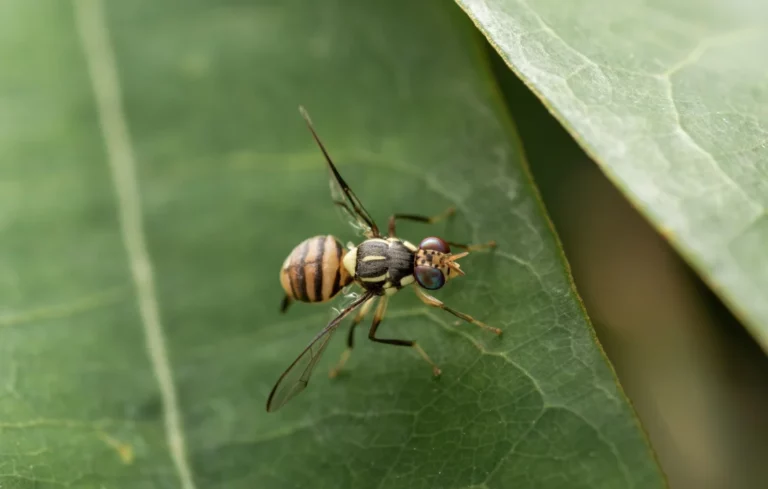
The olive fruit fly (Bactrocera oleae ) remains one of the most closely monitored pests of this crop, as it directly attacks the drupes. The female lays her eggs inside the fruit, and the larva then burrows a tunnel into the pulp, resulting in an oviposition puncture, internal damage, and eventually an exit hole. Fruit drop and secondary damage related to the opening of the drupe are also observed.
Olive moth
The olive moth (Prays oleae ) has a unique profile, as its damage varies depending on the affected organ and the current generation. The larvae can mine the leaves, attack the flowers during blooming, and then affect the young fruit, sometimes resulting in significant fruit drop.
Black olive scale
The black scale insect (Saissetia oleae ), also known as the tortoise scale, is recognizable by its very convex shape and dark brown to black color on leaves and twigs. The adult stages and females feed on the sap, which gradually weakens the tree as populations become dense. Their presence is often accompanied by honeydew, then sooty mold, which blackens the plant parts and hinders leaf function. Its convex shape helps distinguish it from other sap-sucking insects.
Olive psyllid
The olive psyllid (Euphyllura olivina ) is most noticeable in spring on young plant parts, where the larvae produce white, waxy, flaky secretions. This activity is accompanied by honeydew, soiling, and sometimes stunted growth or deformities on young shoots and inflorescences. When the infestation level rises, sooty mold may also develop.
Do you need solutions to combat olive tree pests?
Olive thrips
Olive thrips (Liothrips oleae ) are small, elongated, often dark insects that pierce soft tissues to feed. The foliage may then yellow, become deformed, or dry out in patches, while buds, inflorescences, and young fruits may exhibit abortion or deformation.
Black olive whitefly
The olive black whitefly (Aleurolobus olivinus ) primarily damages leaves. Both the larvae, attached to the leaf blade, and the adults feed on sap and produce honeydew, which promotes the growth of sooty mold. The adults have the typical appearance of small, powdery white insects, while the immature stages remain attached to the leaf. This combination of flying white insects and forms attached to the foliage makes diagnosis easy.
Small olive leaf miner
The small leaf miner (Metriochroa latifoliella ) attacks the leaf blade, where the larva burrows a more or less visible mine. Damage is concentrated on the foliage, and its severity can vary from plot to plot and year to year.
Jasmine moth or olive moth
The olive moth (Palpita vitrealis ) is a moth whose greenish caterpillars feed on young leaves, buds, and sometimes young fruit. The damage takes the form of bites on tender tissues, sometimes accompanied by small silken threads or rudimentary shelters. On young shoots, this feeding can become quite visible.
Olive bark beetle
The olive bark beetle (Phloeotribus scarabaeoides ) is a small wood-boring beetle that burrows galleries under the bark and in the wood. Its attacks result in small holes, expelled woody debris, and progressive drying of the affected twigs or branches. It is often more prevalent on trees that are already weakened, which exacerbates its damage.
Hylesine of the olive tree
Olive leafminer (Hylesinus oleiperda or Hylesinus toranio, depending on the source) also causes galleries in the branches. The affected parts can dry out and then break, with a sign often considered characteristic: a fairly distinct purplish-red discoloration associated with cracked bark.
Olive weevil
The olive weevil (Otiorhynchus cribricollis ) is most easily identified by the distinct notches it leaves along the edges of leaves. The adults, primarily active at night, gnaw at the outer edges of the foliage, giving it a characteristic serrated appearance. In heavy infestations, these bites can accumulate and lead to partial defoliation.
Olive bark gall midge
The bark midge (Resseliella oleisuga ) lives under the bark of twigs, where its larvae cause localized necrosis. The affected twig may turn brown, partially dry out, and young fruit in that area may also wither.
Olive gall midge
The olive gall midge (Lasioptera berlesiana ) is associated with fruit damage, including spots, drupe degradation, and sometimes fruit drop. The reddish-orange larva can be found upon dissection. Its classification may be more nuanced depending on the observed biological context, but its presence on damaged olives is a signal to consider in diagnosis.
Olive leaf gall midge
The leaf gall midge (Dasineura oleae ) causes galls on leaves or young plant parts. These closed deformities house the larvae, allowing them to be distinguished from other open deformities caused by feeding punctures or stress. The impact varies depending on the region and the observed pest pressure, but the mere presence of galls strongly suggests the infestation.
Leopard moth
The leopard moth (Zeuzera pyrina ) is a dreaded wood-boring insect that infests young plants and fragile trees. Its large, bright yellow larva, speckled with black, bores galleries in shoots, branches, or the trunk, which can lead to weakening, breakage, or death in young trees. The presence of sawdust or excrement at the holes is a common sign of infestation.
Goat moth
The goat moth (Cossus cossus ) is another wood pest, capable of burrowing deep galleries that compromise the strength of branches or the trunk. Its very large larvae establish themselves permanently in the wood tissues, with a long life cycle. On olive trees, its presence is mainly indicated by frass and internal decay, sometimes advanced even before the external symptoms become visible. The depth of the galleries is a useful indicator.
Oleander scale
Oleander scale (Aspidiotus nerii ) is a scale insect that can infest leaves, twigs, and fruit. Infestations result in general weakening, leaf drop, partial dieback of twigs, and sometimes fruit deformities. Unlike the black scale, it appears as small, flatter, and lighter-colored shields.
Oystershell scale
The Oystershell scale (Lepidosaphes ulmi ) owes its name to the brownish, elongated shape of its scale. It colonizes twigs, branches, and sometimes fruit, where it forms encrustations that can cause cracking, local weakening, and dieback if the infestation becomes dense.
Olive parlatoria scale
The Olive parlatoria scale (Parlatoria oleae ) also belongs to the group of scale insects and can affect leaves, fruit, and twigs. It causes sap feeding, more or less pronounced weakening, and effects that vary depending on the intensity of the infestation and the growing conditions.
Olive mite
Aceria oleae is a micro-mite invisible to the naked eye, making it more difficult to detect. Damage can affect leaves and fruit, with the extent varying depending on the variety, climate, and cultivation practices.
Olive bud mite
Oxycenus maxwelli also belongs to the Eriophyidae family and primarily affects young leaves, buds, and flowers. The observed manifestations are highly dependent on local conditions and shoot dynamics, which can sometimes complicate interpretation.
Other tips:
- Olive tree diseases
Photo : Shutterstock