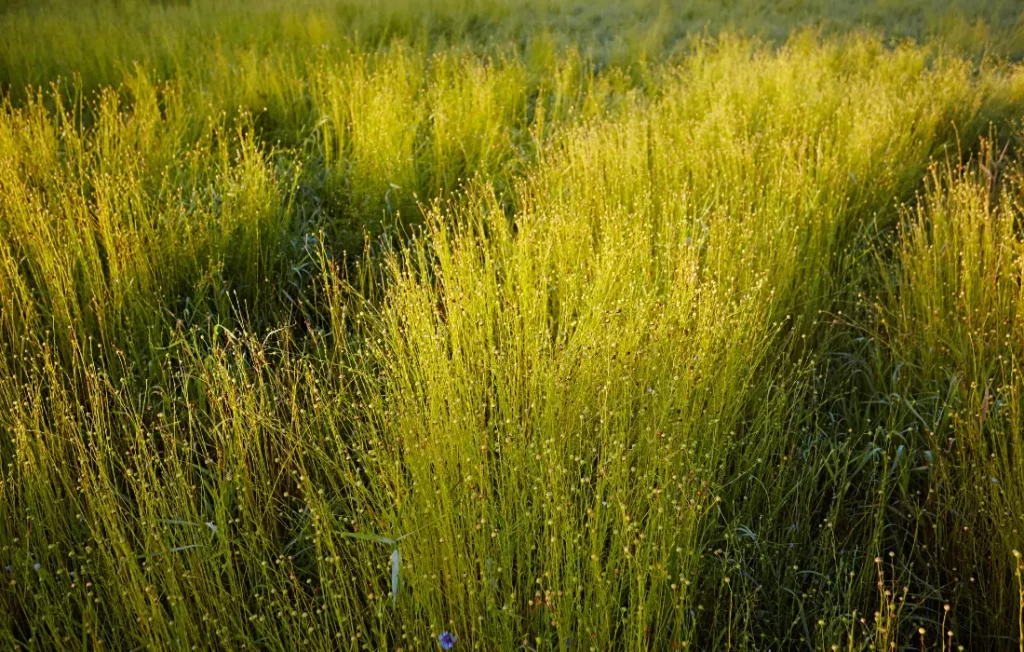
Flax lodging occurs when the stems bend over due to an imbalance between crop management practices, plant vigor, and climatic conditions. Often observed after heavy rain, storms, or windy periods, it generally indicates a field already weakened by high planting density, excess nitrogen, high soil mineralization, or varietal susceptibility. Its consequences can be significant for fiber yield, seed yield, straw quality, and harvesting conditions. Agrobiotop supports flax growers in identifying risks, prevention, and control.
- What is flax lodging?
- What factors contribute to flax lodging?
- At what time of year is flax most susceptible to lodging?
- How do lodged flax plants fare after flowering?
- What are the health risks associated with flax lodging?
- What cultural practices can prevent flax lodging?
- Agrobiotop solutions for controlling flax lodging
What is flax lodging?
Lodging in flax occurs when the stems bend under the influence of climatic, mechanical, or cultural stresses. Storms, excessive rainfall, and strong winds are often perceived as the direct causes, but they more often reveal a crop that is already weakened. A lodging field can suffer losses in fiber yield, seed yield, fiber quality, and straw health. The earlier lodging occurs, the more severe the consequences can be, as the plant has not yet completed its growth or fiber development.
What factors contribute to flax lodging?
Lodging rarely occurs due to a single factor: it most often results from a combination of varietal sensitivities, excessive vigor and unfavorable climatic conditions.
- a variety susceptible to lodging;
- excessive nitrogen fertilization;
- regular manure inputs, which maintain a high availability of nitrogen;
- a previous pasture, often associated with significant mineralization;
- a very fertile or highly mineralized soil;
- too high a plant density;
- rapid growth before flowering;
- rain, storms or strong winds on an already fragile crop.
The denser the crop, the thinner the stems, competing for light, water, and nutrients. The more excess nitrogen is available, the more vigorous, tall, and susceptible the flax plants become. Therefore, managing plant density and nitrogen levels remains the primary focus for minimizing this risk.
Do you need expertise and solutions against flax lodging?
At what time of year is flax most susceptible to lodging?
Flax becomes particularly fragile during the rapid growth phase, just before flowering. At this stage, the stems elongate quickly, the plants remain flexible, and their mechanical strength is not yet fully developed. Growth exceeding 4 cm per day indicates a risky situation, especially if the field already has a high density or high nitrogen availability.
When lodging occurs at this time, the fibers fill less well, fiber yield can fall, seed yield can also be affected, and the final quality of the harvest can degrade.
How do lodged flax plants fare after flowering?
From flowering onwards, flax plants regain more resilience. A crop lying flat in the same direction can sometimes partially right itself, which limits the impact on the harvest. The situation becomes more problematic when the stems intertwine, as they then form a mass that is difficult to lift naturally. If the flax plants remain stuck to the ground, pulling becomes more complicated, machine passage is less consistent, mechanical losses increase, and scutching can be disrupted by heterogeneous or degraded straw.
What are the health risks associated with flax lodging?
Lodged flax retains more moisture in the stems and straw. This persistent moisture creates a favorable environment for the development of diseases, particularly gray mold caused by Botrytis cinerea and sclerotinia blight caused by Sclerotinia sclerotiorum. These diseases can cause stem rot, weaken the straw, and increase breakage during harvesting. In severe cases, the crop can lose some of its fiber value, or even become very difficult to market if the disease is advanced.
What cultural practices can prevent flax lodging?
Prevention relies first and foremost on cultivation practices adapted to the potential of the plot, the type of soil and the expected level of risk.
- choose a variety less susceptible to lodging when the field context is favorable to bedding;
- avoid excessive densities, as a stand that is too dense produces thinner and more fragile stems;
- adjust the sowing dose to obtain a regular stand without excessive competition;
- carefully consider nitrogen fertilization based on residual nitrogen, previous crop, and soil fertility;
- limit excess nitrogen after the 10 cm stage;
- take into account regular organic inputs, including manure and previous grassland;
- monitor the rapidly growing plots before flowering, especially after rain or mild periods.
Agrobiotop solutions for controlling flax lodging
We recommend coating your seeds using:
As well as the application of:
Feel free to contact us for advice and for the implementation of the solutions presented above.
Photo : Shutterstock