
Boron is a trace element required by grapevines in very small quantities, but a deficiency can quickly disrupt the vine’s function. A deficiency can affect growth, flowering, fruit set, harvest quality, wood ripening, and ultimately, the long-term health of the vineyard. Agrobiotop supports winegrowers in identifying these situations and implementing natural solutions tailored to each plot.
What is a boron deficiency in grapevines?
Boron deficiency is one of the most damaging non-parasitic disorders affecting grapevines. Although this trace element is required in very small quantities, it plays a crucial role in the transport and utilization of sugars within the plant. It thus contributes to regular flowering, fruit set, berry formation, uniform ripening, and sugar content. When it is lacking, vegetative development can be disrupted, while stamen emergence and pollen germination capacity decrease. Normal berry formation is then compromised, with direct consequences for bunch quality, harvest maturity, and vine longevity.
Do you need expertise and solutions to combat boron deficiency in vines ?
Soils and conditions that promote boron deficiency
Certain soil characteristics and climatic events reduce the availability or absorption of boron by the vine:
- Sandy , gravelly or gravelly soils, where boron is more susceptible to leaching .
- Soils with high pH and terrains rich in calcium, especially limestone, limit the availability of the element.
- Soils with high nitrogen content, which can disrupt the mineral supply to the vine.
- Periods of cold and humidity , which slow down root activity and boron absorption.
- Drought episodes, which limit water circulation in the soil and the assimilation of mineral elements.
What are the symptoms of a boron deficiency?
The manifestations of the deficiency can simultaneously affect the foliage, the twigs and the clusters.
On the leaves:
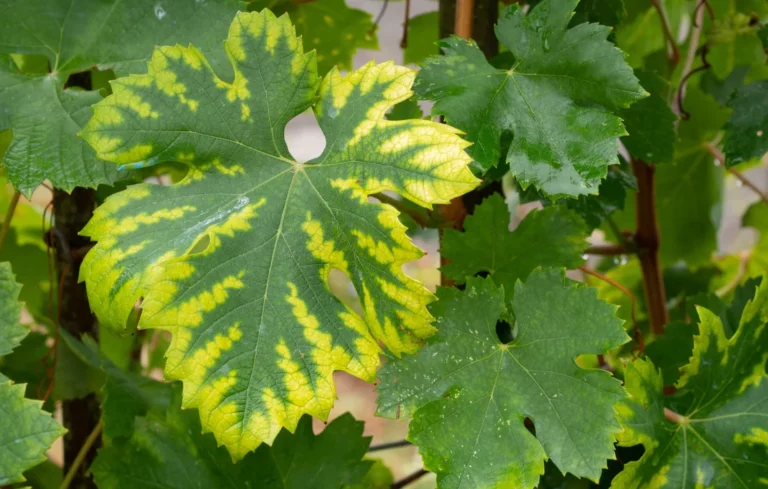
Discolored patches typically appear around the leaf margin. These often turn yellow, while their centers may become reddish on red grape varieties. The edges remain indistinct, and the veins frequently remain greener than the tissue between them. As the disorder worsens, the discolored areas progress to interveinal necrosis. The leaf blade may become thicker, harder, and blistered, with drying of the center of the spots or necrosis along the serrations. In the most severe cases, the leaves remain small, stunted, and poorly developed.
On the branches
The tip of the vine may stop growing prematurely. It then develops numerous lateral branches in the terminal section, sometimes arranged in a zigzag pattern. This “witch’s broom” appearance is accompanied by shorter internodes and a bushier, sometimes yellowish, growth habit. The lignification process may remain incomplete, weakening the shoots and reducing their ability to reach full maturity.
At flowering, fruit set, and on the grape clusters
The deficiency can lead to the drying out of some of the inflorescences. It promotes coulure (poor fruit set), disrupts fruit set, and can cause millerandage (shot berries). Later, some berries remain small, metallic green, slightly depressed, and unable to reach normal maturity. They may drop before harvest. Brown tissue may also form under the skin: this symptom corresponds to berry compaction .
How to detect a boron deficiency?
The diagnosis must combine observations made in the plot with analyses that allow the symptoms to be placed in the context of the soil and the vine’s nutrition:
- Leaf analysis allows us to assess the level of boron present in plant tissues and to confirm a deficiency when the observed symptoms are compatible.
- Soil analysis helps to identify terrain-related factors, including texture, pH, limestone content, and conditions that may limit boron availability.