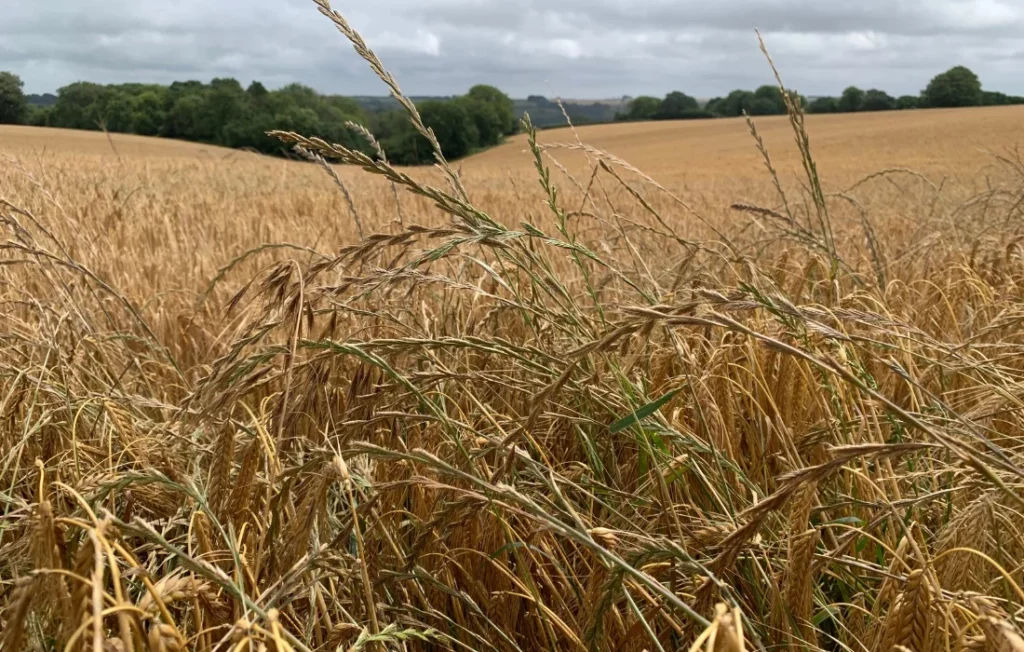
Ryegrass is currently one of the most difficult weeds to control in cereal crops, particularly soft wheat. The development of resistance, facilitated by the repeated use of solutions based on the same modes of action, limits the effectiveness of herbicides in many fields. Control must now rely on a comprehensive strategy, adapted to crop rotation, tillage practices, and the observed weed pressure. Agrobiotop supports producers in implementing natural solutions to sustainably reduce ryegrass in cereal crops and other agricultural production.
What is ryegrass?
The term ryegrass encompasses several species of darnel in the genus Lolium , including Italian ryegrass ( Lolium multiflorum ) and stiff ryegrass ( Lolium rigidum ). In a field, this grass is recognizable by its upright habit, its hairless and often glossy foliage, a sometimes reddish sheath base, a short ligule, and blunt auricles. Depending on growing conditions, ryegrass can reach 70 to 120 cm in height and produce its seed heads in late spring.
Its ability to rapidly colonize plots is due to its highly adaptable biology. Emergence can occur throughout the year, with a marked peak between September and December, followed by a second peak in early spring. The seeds germinate mainly at a depth of 1 or 2 cm, but some are still capable of emerging at a depth of 5 or 6 cm. With a short dormancy period, a significant proportion of the seeds germinate quickly when the soil has sufficient moisture. Each plant can produce between 500 and 5,000 seeds, sometimes more when the number of ears is high.
Why is ryegrass becoming resistant?
Ryegrass resistance relies on a mechanism of natural selection. When the same mode of action is repeated over several growing seasons, susceptible plants disappear while naturally less susceptible individuals survive and produce seeds. The proportion of resistant plants then increases within the field, eventually making interventions less and less effective. This phenomenon accelerates when crop rotation, sowing dates, and tillage practices remain relatively undiversified.
The following practices increase the risk of the emergence or worsening of resistance:
- Too short a rotation , with the frequent return of the same winter crops, does little to disturb the ryegrass cycle and maintains conditions favorable to its emergence.
- The repetition of the same modes of action , which progressively selects the individuals capable of surviving; reasoning must therefore be carried out by group of modes of action, and not only according to the specialties used.
- Inappropriate doses , because underdosing can leave partially tolerant plants in place, while an excess can weaken the crop and reduce its competitive ability.
- Soil work that is inconsistent with the history of the plot , as some interventions can bring seeds to the surface or promote new emergence.
- Systematic or poorly positioned plowing , while it can be useful on occasion to bury part of the seed bank, must remain integrated into a multi-year strategy.
Do you need expertise and solutions against ryegrass?
Why does ryegrass pose a major problem in cereal crops?
In winter cereals, ryegrass often emerges at the same time as common wheat, barley, or triticale. It then enters into early competition for light, water, nitrogen, and available space. Early and dense emergence directly hinders crop establishment, reduces ground cover, and can lead to yield losses. The difficulty increases when ryegrass is already well established before the cereals begin tillering.
The problem extends beyond the current growing season. The seeds produced gradually replenish the soil seed bank and maintain seed pressure for several years. A heavily infested plot then becomes more difficult to manage, especially when the same crops, sowing times, and practices are repeated regularly.
Agrobiotop addresses the ryegrass problem as a crop issue and not as a weed limited to a single plot or a single season (see our solutions below).
Ryegrass also affects many other crops. It is common in rapeseed, protein crops, flax, and forage seed crops. Its presence is also increasing in some spring crops, such as peas, sugar beets, sunflowers, and maize. In rapeseed, competition from grasses from the beginning of the growth cycle weakens establishment and can limit the development of young plants. Ryegrass, along with blackgrass , is therefore among the most closely monitored weeds in many large-scale cropping systems.
The main agronomic levers to be mobilized
Sustainable weed pressure reduction relies on a combination of agronomic strategies, tailored to the level of infestation, the seed bank, and the crop rotation of each farm. Clay soils and hydromorphic silts present challenges for timely cultivation due to their sensitivity to moisture. Compaction, poor aeration and oxygenation, and organic matter saturation in some plots promote ryegrass establishment.
Agrobiotop solutions for controlling ryegrass
In summary, ryegrass often proliferates in:
- short rotations / cereals
- compacted and poorly oxygenated soils
- soils saturated with organic matter
- excesses of mineral nitrogen rapidly
We recommend:
Saving time in the fields, quick and easy to implement, SILIBOOST (powder) and SOUFREL (granules) are the two allies for eliminating ryegrass in crops. Don’t hesitate to contact us for advice and for implementing the solutions presented above.