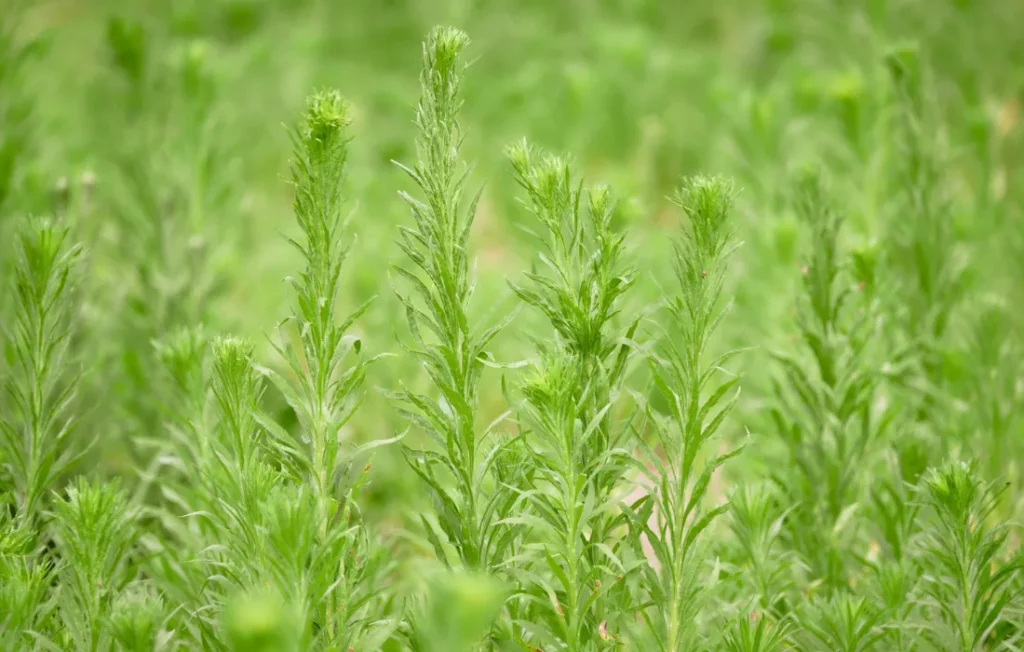
Long considered a minor weed, fleabane is now a serious threat in vineyards, orchards, vegetable gardens, and lightly tilled fields . Its ability to rapidly colonize bare soil, produce thousands of wind-dispersed seeds, and develop resistance to several herbicides makes control extremely difficult. To address this spread, understanding its biology, impacts, and available control methods allows for the development of a more sustainable strategy at the field level.
What are the problematic weeds in agriculture?
The term Erigeron encompasses several species of the Asteraceae family, three of which are mainly observed in French crops.
| Common name | Current botanical name | Old name still in use |
| Canada’s fleabane | Erigeron canadensis | Conyza canadensis |
| Sumatran erigeron | Erigeron sumatrensis | Conyza sumatrensis |
| Buenos Aires Erigeron | Erigeron bonariensis | Conyza bonariensis |
Canadian fleabane typically has narrow, sparsely hairy, slightly yellowish-green leaves. Sumatran fleabane often has broader, grayish foliage covered in dense hairs. Buenos Aires fleabane, on the other hand, tends to branch out more from the base.
The three species begin their cycle with a rosette pressed against the ground, before sending up an upright stem that can reach about 50 centimeters to 2 meters depending on the species, water availability and the fertility of the environment.
This stem bears numerous small flower heads capable of producing seeds with a white pappus. Two cycles can coexist in the same plot: plants that emerged in autumn overwinter in a rosette before bolting in spring, while spring seedlings develop and flower during the same year.
Do you need expertise and solutions
against erigeron ?
Why does this weed grow so easily?
The progression of the erigeron is based on several biological characteristics that simultaneously promote its reproduction, dispersal and establishment on sparsely covered soils.
- A particularly high seed production. A well-developed plant can produce up to approximately 200,000 seeds. Their small size and pappus facilitate wind dispersal. The majority fall back near the parent plant, but some can reach more distant plots. An infestation can thus originate from an embankment, a fallow field, a path, a ditch, or a neighboring plot. A single mature plant can be enough to create a new infestation.
- Germination is primarily localized to the surface. The seeds need light and germinate best when they remain in the first few millimeters of soil. Their germination rate decreases significantly when buried deeper than 0.5 to 1 centimeter. Bare inter-rows, raised beds, machinery tracks, stony soils, compacted areas, and systems with minimal soil disturbance therefore offer favorable conditions.
- Several waves of emergence occur throughout the year. Some plants may appear as early as autumn, remain in a rosette form over winter, and then resume growth in spring. Others germinate in spring or early summer. Monitoring limited to a single period often allows a new generation to establish itself.
- A regularly replenished seed bank. The seeds generally exhibit little dormancy, and their persistence in the soil remains relatively short compared to that of other weeds. This weakness can become an advantage for the farmer when all new seed production is prevented for several seasons. Conversely, a few escaped plants can produce enough seeds to negate previous efforts.
No-till or reduced-till systems do not automatically lead to infestation. However, they do require more rigorous management of plant cover, field margins, and fallow periods. The less disturbed and bare the soil remains, the more light and open spaces the seeds have to germinate.
Which crops are affected and what damage does it cause?
Erigeron thrives mainly in perennial crops and systems where the soil surface remains relatively undisturbed for a prolonged period.
Vineyards and orchards
In vineyards and orchards , weeds frequently establish themselves under the vines, around the trunks, at the base of trees, and in areas difficult to reach with mechanical tools. Young plantings, shallow soils, and plots exposed to summer droughts are particularly susceptible to competition for water.
A dense population also depletes minerals, hinders the passage of tools, and, after bolting, forms tall, fibrous stems that are more difficult to uproot. Individuals left in the margins or around trunks simultaneously maintain a steady flow of seeds across the entire plot. French populations resistant to glyphosate have been primarily identified in vineyards, where the repetition of similar practices over several years has exerted strong selection pressure.
Large-scale crops
In large-scale farming , fleabane thrives primarily in rotations managed with no-till, simplified tillage, or long intercropping periods. It can be present before planting corn, soybeans, sunflowers, or cereals, and then continue to develop within the crop if ground cover is slow to establish. A rosette established before sowing already has a functional root system and priority access to water. Its harmfulness therefore depends as much on its density as on its emergence date.
Market gardening
In vegetable gardens and nurseries , fleabane thrives in the spaces between beds, along service paths, tunnel edges, and during the periods between crops. Seeds can be carried by the wind, but can also be transported with contaminated plugs, seedlings, pots, or substrates. Established plants complicate manual operations, slow harvesting, and can contaminate marketed batches. When control relies in part on uprooting, delayed intervention quickly increases labor time, as the roots are stronger and the stems can already bear several hundred flower heads.
Why is herbicide resistance a major problem?
Fleabane illustrates the limitations of a strategy that relies heavily on the same mode of action. Resistance to glyphosate has been documented in several countries, and some French populations have been identified, particularly in vineyards. Resistance to inhibitors, including flazasulfuron, has also been reported. Their emergence results from a selection process: naturally less susceptible individuals survive repeated applications, produce seeds, and pass on their traits to the next generation.
This selection is favored when the same mode of action is frequently used, when established plants escape treatment, or when a few survivors are allowed to flower. However, insufficient efficacy alone does not prove the presence of resistance. Plant growth stage, drought, application conditions, foliage cover, or rain following treatment can also explain a disappointing result. Resistance becomes more likely when fleabane of comparable size repeatedly survives in a specific area, while other weeds present have been controlled. These pockets must be identified, mapped, and prevented from producing seeds, as wind dispersal can quickly spread the problem to the rest of the farm.
How to control the erigeron with an integrated strategy?
Sustainable management of fleabane relies on a series of actions designed to reduce emergence, destroy young plants and interrupt the renewal of the seed bank.
- Prevent seed production. The first patches must be pulled up, cut, or destroyed before flowering. Plants already bearing flower heads should be removed from the plot, as some seeds can continue to mature after a late cut. Mowing is not always sufficient: a fleabane cut too high can branch out from its base and produce new flower heads. Borders, ditches, paths, fence posts, greenhouse areas, and storage areas should be monitored with the same care as cultivated fields.
- Intervene at the seedling or small rosette stage. A young plant has limited root development and tissues that are easier to damage. Hoeing, weeding, pulling, or shallow tilling then gives more consistent results. After stem elongation, the root is better established, and the stem can regrow if it hasn’t been completely severed or uprooted. Therefore, observations should begin before the plants become visible above the crop.
- Maintaining ground cover is essential. Fleabane struggles to germinate when light doesn’t reach the surface. Dense cover crops, a crop that quickly closes the row, a sufficiently thick layer of organic mulch, or controlled grass cover all limit the available space. In vineyards and orchards, the choice of cover crop must take into account water reserves, soil depth, and the vigor of the plants. The goal is to reduce bare patches without introducing vegetation that would excessively compete with the crop.
- Mobiliser le travail mécanique de manière ciblée. Un passage réalisé sur de petites rosettes peut déraciner les plantes et exposer leurs racines à la dessiccation. Un travail plus profond peut aussi enfouir les graines au-delà de la zone favorable à leur germination. Le faux-semis permet, pour sa part, de provoquer une première vague de levée avant de la détruire. L’efficacité dépend fortement de l’humidité du sol, du stade des plantes et de la qualité du déracinement. Un passage sur un sol humide peut laisser des rosettes reprendre racine, tandis qu’une intervention sur des plantes déjà hautes donne souvent des résultats irréguliers.
Agrobiotop solutions for controlling fleabane
We recommend the following solutions:
Please feel free to contact us for advice and support with implementing the solutions presented above.
Photo : Shutterstock